BACKGROUND
Sensory processing sensitivity (SPS), a core trait within the environmental sensitivity (ES) framework, reflects individual differences in processing internal and external stimuli (Aron & Aron, 1997; Pluess, 2015). Defined by heightened emotional reactivity, deep cognitive processing, and increased sensitivity to environmental cues (Aron et al., 2012), SPS is considered a normative personality trait rather than a sensory disorder. This heightened responsiveness may confer adaptive advantages, such as greater awareness of emotional changes. SPS is normally distributed in the population, with an estimated 30% classified as highly sensitive (Boyce & Ellis, 2005; Greven et al., 2019).
Aron and Aron (1997) developed the Highly Sensitive Person Scale (HSPS) to assess environmental and emotional responsiveness differences (Greven et al., 2019; Pluess et al., 2018). While initially conceptualized as unidimensional, subsequent research revealed multiple factor structures: two factors (Negative Emotionality, Orienting Sensitivity) (Evans & Rothbart, 2008), three factors (Ease of Excitation – EOE, Aesthetic Sensitivity – AES, Low Sensory Threshold – LST) (Booth et al., 2015; Smolewska et al., 2006), and four factors (general sensitivity/overstimulation, adverse reactions, psychological fine discrimination, controlled harm avoidance) (Meyer et al., 2005). The inconsistent factor structure across studies may reflect the development of the HSPS without cultural heterogeneity (Pluess et al., 2018).
The Highly Sensitive Person Scale has demonstrated extensive psychometric validation through numerous studies (Booth et al., 2015; Jagiellowicz et al., 2016). Based on the HSPS (Aron & Aron, 1997; Pluess et al., 2023), subsequent tools were developed: the Highly Sensitive Child Scale (HSCS; Pluess et al., 2018; Weyn et al., 2021) and the HSC-Rating System (Lionetti et al., 2019). The HSCS maintains a three-factor structure consistent with the adult scale, comprising a general factor and three subscales: AES (representing positive emotionality – the ‘bright’ side) and EOE/LST (indicating negative contextual sensitivity – the ‘dark’ side) (Pluess et al., 2018). Additional studies have further validated the HSCS’s psychometric properties (Greven et al., 2019).
In addition, the HSCS has been validated for children, adolescents, and young adults around 18-19 years (Pluess et al., 2018). Although sensory processing sensitivity (SPS) manifests differently across age groups, both the HSPS and the HSCS effectively capture similar physical, cognitive, emotional, and social aspects of sensory processing (Lionetti et al., 2019). Recent research emphasizes the value of concise 12-item assessments for SPS, highlighting the need for improved, efficient evaluation tools for adult populations (Pluess et al., 2023).
Research indicates a growing need to study environmental sensitivity across the lifespan, with researchers noting limited availability of reliable instruments valid for both children and adults (Riglin et al., 2021). While existing Spanish HSPS versions demonstrate different dimensional structures – five dimensions (Chacón et al., 2021) and six dimensions (Ponce-Valencia et al., 2022) – we hypothesize that the new Spanish HSCS-A will capture similar but distinct aspects of environmental sensitivity. This instrument’s value lies in its potential for valid assessment and comparison of sensitivity traits across the lifespan, from childhood through adulthood.
Furthermore, researchers have voiced different opinions about adapting personality tests for different ages. However, it seems that scientific investigations have led to a general consensus that some personality traits are stable not only in adults but also in early ages (Antoñanzas, 2021). Also, some questionnaires, such as the Big Five Questionnaire, have been adapted for children, adolescents, and adults (Antoñanzas, 2021).
Therefore, based on the recent scientific literature and the similar psychometric analysis results in samples aged 15-19 years old (Pluess et al., 2018), the current research aimed at determining the psychometric evidence of the Spanish 12-item version of the Highly Sensitive Child Scale in an adult sample with a wide range of ages (HSCS-A), setting the following objectives: (a) to explore the goodness-of-fit indices to confirm the accuracy of the HSCS-A structure subjected to a confirmatory factor analysis (CFA); (b) to examine measurement invariance across age; (c) to examine the internal consistency reliability coefficients of HSCS-A scores; and (d) to test the convergent validity between the HSCS-A and the HSPS-27.
PARTICIPANTS AND PROCEDURE
DESIGN
We tested a brief cross-cultural adaptation of the original HSCS version for Spanish adults, which was previously adapted in Spanish children by Costa-López et al. (2022), following the guidelines outlined in the Questionnaire Translation Protocol (Pluess, 2020).
PARTICIPANTS
A total of 372 Spanish adults (76.34% female, n = 284), aged from 18 to 75 years (M = 39.15, SD = 10.81), from the local community in Spain, completed the full set of questionnaires to participate in this study. Participants were undergraduate and postgraduate students (65.86%), and the majority were in a relationship (n = 285; 76.61%). Convenience sampling was employed in this research, and the inclusion criteria were: 1) Spanish nationality; 2) above 18 years old; and 3) sufficient level of reading comprehension to complete the evaluation protocol. Not speaking the Spanish language, and presenting sensory, physical, or psychological impairments which make it difficult to fill out the evaluation instrument, were exclusion criteria in this study. Table S1 in Supplementary materials presents sociodemographic data of the sample. From the general sample, 233 participants were randomly selected to analyze the convergent validity. Also, according to Tabachnick et al. (2013), a minimum of 15 people per item is required for factor analysis.
INSTRUMENTS
An ad-hoc questionnaire was used to assess sociodemographic data of the participants. Information related to age, gender, level of education, and marital status was collected.
The Highly Sensitive Child Scale for Adults (HSCS-A) is an adapted version of the HSCS, initially designed to assess environmental sensitivity in children (Pluess et al., 2018). It comprises 12 self-report items rated on a 7-point Likert scale (1 – not true at all to 7 – extremely true) and measures three dimensions: (a) Ease of Excitation (EOE; being easily overwhelmed by internal or external stimuli – 6 items), (b) Aesthetic Sensitivity (AES; prone to being influenced by aesthetic stimuli such as music and art – 4 items) and (c) Low Sensory Threshold (LST; sensitivity to subtle external stimuli – 3 items). Original reliability indices were acceptable (total α = .79; EOE = .71; AES = .73; LST = .66). The Spanish version, originally validated via parent report (Costa-López et al., 2022), showed good internal consistency (total α = .84; AES = .77; LST = .73; EOE = .86) and has been adapted in several languages. The test was applied to adults in this study as HSCS-A.
The Highly Sensitive Person Scale (HSPS-27) is a widely used self-report measure of sensory processing sensitivity (SPS) in adults (Aron & Aron, 1997; Chacón et al., 2021), comprising 27 items rated on a 7-point Likert scale (1 – not true at all to 7 – extremely true). The Spanish version measures five dimensions: Sensitivity to Overstimulation (SOS), Low Sensory Threshold (LST), Aesthetic Sensitivity (AES), Psychophysiological Discrimination (FPD), Harm Avoidance (HA). The Spanish version shows high internal consistency (α > 0.9). It was used as the gold standard for the convergent validity to assess sensory processing sensitivity in adults (Greven et al., 2019).
PROCEDURE
After receiving ethical approval from the Ethics Committee of the University of Alicante (UA-2022-05-23_2), the general population in Spain was invited to participate in the research. The invitation was disseminated through social networks, and participants were recruited using a non-probabilistic convenience sampling approach combined with a snowball technique (Parker et al., 2019). Participants were presented with an online informed consent form, which included the authorization statement and the possibility to withdraw or cancel the participation at any time. They then completed an online questionnaire, which took approximately ten minutes. Adults participated voluntarily and anonymously, and they were provided with no remuneration. Necessary measures were implemented to ensure the protection of the information according to the Organic Law 3/2018 concerning data protection and the assurance of digital rights.
DATA ANALYSIS
Data analyses included descriptive statistics (means, SDs, frequencies). To examine internal structure, the sample was randomly split: exploratory factor analysis (EFA) was conducted on Subsample 1 and CFA on Subsample 2. Sampling adequacy was confirmed via the Kaiser-Meyer-Olkin (KMO) measure and Bartlett’s test. The EFA used ML estimation with Varimax rotation. CFA was performed in R (Rosseel et al., 2021) using robust ML estimation (MLR), comparing one-factor, three-factor, and bifactor models. Fit was evaluated with Yuan-Bentler χ2 (p > .05), CFI ≥ 0.90, RMSEA = 0.05-0.08, and SRMR ≤ 0.08 (Green & Yang, 2009).
Reliability was assessed using Cronbach’s α and McDonald’s ω (Leary, 2001; McDonald, 1999), interpreted as low (≤ .60), acceptable (.60-.70), or good (≥ .70). Average inter‑item correlation (AIC) was also calculated to examine item homogeneity, with optimal values ranging from 0.15 to 0.50 depending on construct breadth (Clark & Watson, 1995).
Measurement invariance across age groups was tested using ML estimation suitable for Likert-type data (Rhemtulla et al., 2012; Rand-Giovannetti et al., 2020). Configural, metric, and scalar invariance were examined via multigroup bifactor CFA. Partial invariance was explored when full invariance failed (Wang et al., 2018). Invariance was supported when ΔCFI < 0.010, ΔRMSEA < 0.015, and ΔSRMR < 0.030 (metric) or < 0.010 (scalar). ΔYB-χ2 was also considered (Chen, 2007). The child sample (n = 141; M = 6.75, SD = 2.27; 51.8% male) matched that of Costa-López et al. (2022) to ensure comparability.
Convergent validity was assessed via Pearson’s correlations in Jamovi v1.6 (p < .05). Correlation strength was classified as null (< 0.10), weak (0.11-0.30), moderate (0.31-0.50), or strong (> 0.50) (Cohen, 2013).
RESULTS
DESCRIPTIVE ANALYSIS AND HSCS-A PERFORMANCE
Means, standard deviations, ranges, and percentiles were used as descriptive statistics for HSCS-A items. The test was designed with a 7-Likert scale response, and a floor effect for most of the items was observed (see Table 1).
Table 1
Performance of the scale and related descriptive data
EXPLORATORY FACTOR ANALYSIS OF THE HSCS-A
EFA was conducted on Subsample 1 (n = 186). Sampling adequacy was acceptable (KMO = 0.83; Bartlett’s test: χ2(66) = 722.90, p < .001). A three-factor solution emerged: Factor 1 (Ease of Excitation; items 4, 6, 8, 9, 12) reflects sensitivity to internal and external demands; Factor 2 (Aesthetic Sensitivity; items 1, 3, 5, 10) captures awareness of aesthetic stimuli; Factor 3 (Low Sensory Threshold; items 2, 7, 11) relates to sensory overstimulation. Detailed loadings are reported in Supplementary materials (Table S2).
CONFIRMATORY FACTOR ANALYSIS AND FIT INDICES
CFA was conducted on Subsample 2 (n = 186) to compare a one-factor, three-factor, and bifactor structure of the HSCS-A. The one-factor model showed poor fit (see Table S3 in Supplementary materials), while the bifactor model demonstrated the best fit across indices: χ2(36) = 42.82, CFI = .98, TLI = .98, RMSEA = .03, SRMR = .03, 95% CI [.03, .06]. Most factor loadings in the three-factor structure exceeded .43 (range = .428-1.563; see Figure 1), supporting retention of all items.
Figure 1
Standardized factor loadings of the one-factor and the three-factor structure of the Spanish version of the HSCS-A (N = 186)
Note. HSCS-A – Highly Sensitive Child Scale for Adults. EOE – Ease of Excitation: It4, It6, It8, It9, and It12; LST – Low Sensory Threshold: It2, It7, and It11. AES – Aesthetic Sensitivity: It1, It3, It5, It and It10; HSCS-A – general sensitivity factor: It1-It12.
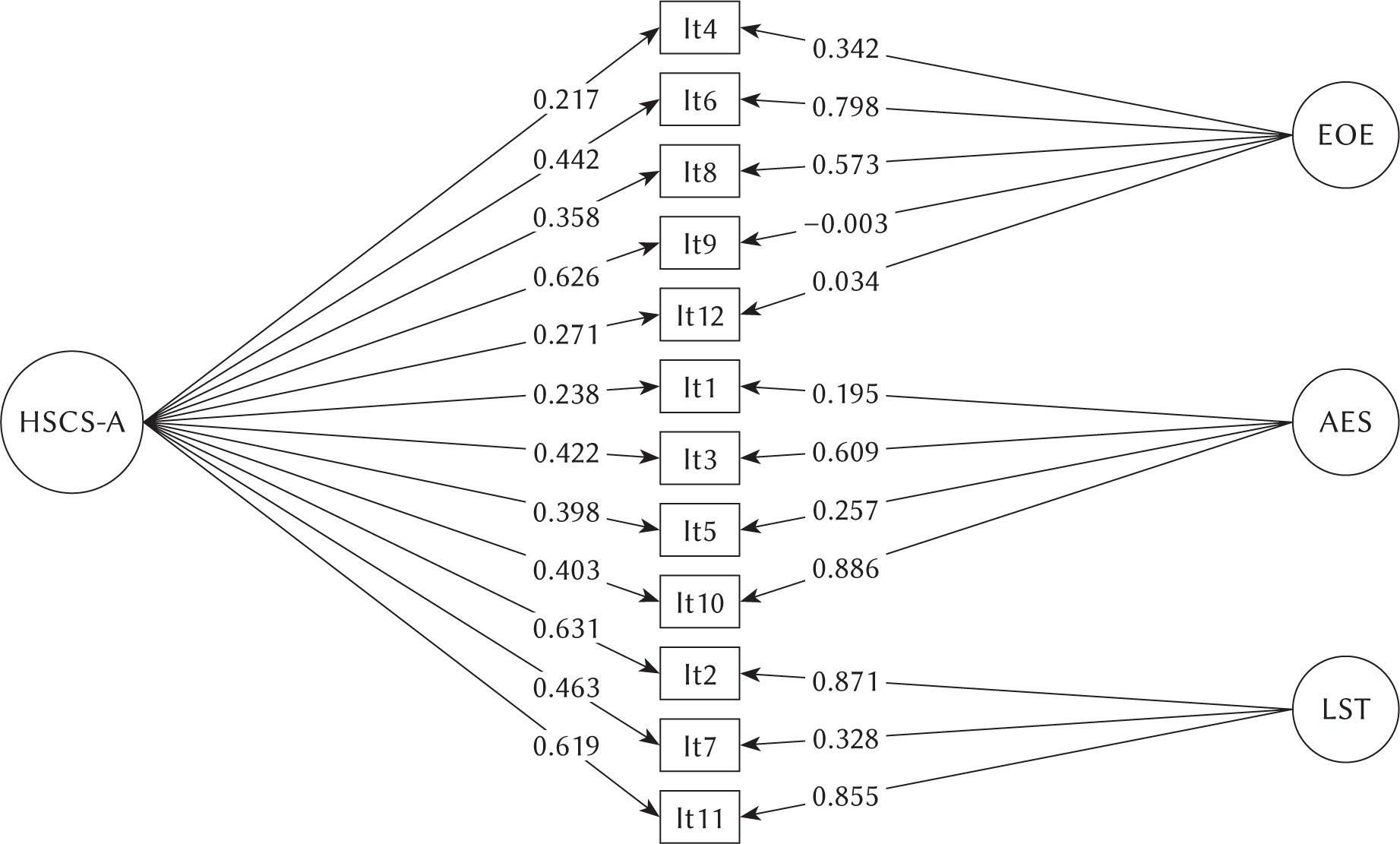
The scale comprises three dimensions: Ease of Excitation (EOE; Items 4, 6, 8, 9, 12), reflecting susceptibility to internal and external demands; Aesthetic Sensitivity (AES; Items 1, 3, 5, 10), indicating heightened aesthetic awareness; and Low Sensory Threshold (LST; Items 2, 7, 11), capturing adverse reactions to sensory input.
MEASUREMENT INVARIANCE
Measurement invariance across children and adults was examined (see Table S4 in Supplementary materials). Configural invariance was supported, indicating a consistent factor structure across groups. Metric invariance was confirmed, with fit indices within acceptable thresholds (ΔCFI < .010; ΔRMSEA < .015; ΔSRMR < .030), suggesting equivalent item-factor relationships. Scalar invariance was also supported, indicating that group differences in observed scores reflect true differences in the latent traits rather than measurement bias.
RELIABILITY
The HSCS-A demonstrated acceptable overall reliability (α = .81; ω = .82). Among subscales, EOE showed the highest internal consistency (α = .80; ω = .81), followed by LST (α = .74; ω = .77), and AES (α = .55; ω = .57). AIC values indicated adequate internal homogeneity for the general scale (0.25) and AES (0.25), while EOE (0.44) and LST (0.50) reflected narrower constructs (Clark & Watson, 1995). Most corrected item-total correlations exceeded 0.30, except for Items 3 and 5. Removing these items slightly improved reliability (see Table S5 in Supplementary materials), though they were retained due to their conceptual relevance.
CONVERGENT VALIDITY
Table S6 in Supplementary materials shows bivariate correlations between the HSCS-A and the HSPS-27 in a subsample (n = 233). Strong, significant correlations across total scores and subscales support the convergent validity of the HSCS-A, consistent with European standards for test quality (Hernández et al., 2020). Lower correlations were observed between LST (HSCS-A) and SOS, LST (HSCS-A–HSPS-27), FPD, and HA.
DISCUSSION
This study examined the adaptation and validation of the Spanish 12-item HSC scale for adults, a brief version of the HSPS widely used across languages to assess environmental sensitivity (Pluess et al., 2018). Its clinical relevance lies in the potential to identify up to 50% of highly sensitive individuals in consultations (Bordarie et al., 2022; Greven et al., 2019). Additionally, it serves as a valuable screening tool for psychologists to detect high sensitivity and better understand patients’ daily habits (Smith et al., 2022).
Although Aron and Aron (1997) proposed a unidimensional structure for the original 27-item HSPS, our findings support the multidimensional nature of SPS, consistent with international research (Baryła-Matejczuk et al., 2022a, 2022b; Greven et al., 2019). The bifactor model showed the best fit, aligning with studies that include a general sensitivity factor and three dimensions: EOE (emotional reactivity to psychophysiological stimuli), AES (introspection and deep cognitive processing), and LST (heightened excitability from external sensory input) (Assary et al., 2020; Booth et al., 2015; Evans & Rothbart, 2008; Konrad & Herzberg, 2019; Pluess et al., 2023; Smolewska et al., 2006; Sobocko & Zelenski, 2015). Two other Spanish versions of the HSPS have been validated with five and six factors, respectively (Chacón et al., 2021; Ponce-Valencia et al., 2022). The five-factor version includes SOS, AES, LST, FPD, and HA; the six-factor version comprises Instability, Environment, Interaction, Sensoperception, and Insecurity. In contrast, the present HSCS-A captures core sensitivity dimensions and offers a practical tool for use across age groups, facilitating comparisons between children and adults in Spanish populations.
As the current Spanish HSCS-A is based on the original HSCS, our results align with previous findings (Pluess et al., 2018; Weyn et al., 2021) and those obtained in Spanish children (Costa-López et al., 2022). The bifactor model with a general sensitivity factor and three group factors (EOE, LST, AES) was confirmed. Similarly, the HSPS-12 (Pluess et al., 2023), derived from the HSPS-27, reflects the same structure and shares subscales and items with our HSCS-A, highlighting their common origin in the original HSPS.
The bifactor structure of the Spanish HSCS-A supports using the total score to assess general sensitivity, while subscales capture specific traits (Assary et al., 2020; Pluess et al., 2018; Weyn et al., 2021). This suggests that both this adaptation and future sensitivity measures may extend beyond the original unidimensional model (Aron & Aron, 1997; Konrad & Herzberg, 2019). Consistent with recent theoretical frameworks, the HSCS-A reflects key aspects of environmental sensitivity as a multidimensional construct (Greven et al., 2019).
The findings provide strong psychometric support for the Spanish HSCS-A’s applicability across age cohorts. Configural, metric, and scalar invariance confirm a stable factorial structure in both child and adult samples, allowing valid comparisons of latent sensitivity across developmental stages. This supports the view of sensory processing sensitivity (SPS) as a stable psychological trait (Chen, 2007; Wang et al., 2018). Scalar invariance is especially important, ensuring that score differences reflect true differences in sensitivity rather than measurement bias. Consistent with recent perspectives on SPS as biologically grounded and developmentally stable (Assary et al., 2020; Pluess et al., 2018), these results validate the HSCS-A as a reliable tool for assessing environmental sensitivity across the lifespaPrevious studies have reported strong reliability for the HSPS, with Cronbach’s α values above 0.8 and up to .93-.95 (Aron & Aron, 1997; Evans & Rothbart, 2008; Hofmann & Bitran, 2007; Konrad & Herzberg, 2019; Smolewska et al., 2006; Taber, 2018). Our findings confirm adequate psychometric properties, with both Cronbach’s α and McDonald’s ω exceeding 0.8 for the general sensitivity factor. Good reliability was also found for EOE (α = .80; ω = .81) and LST (α = .74; ω = .77), though lower values were observed for AES (α = .55; ω = .57), consistent with recent studies reporting AES as the least reliable subscale (Booth et al., 2015; Smolewska et al., 2006; Sobocko & Zelenski, 2015).
Regarding convergent validity, our study found moderate to strong correlations between the Spanish HSPS-27 and HSCS-A factors, suggesting validity among aspects of high sensitivity. However, AES showed distinctively lower correlations with the HSPS-27 total scale and its subscales, aligning more closely with the AES of HSPS-27 and its total score. This supports the idea that both dimensions assess the same construct. Additionally, results on factor structure, internal consistency, and convergent validity indicate that aesthetic sensitivity represents a distinct feature of environmental sensitivity, associated with a more positive response to the environment compared to EOE and LST (Pluess et al., 2018; Smolewska et al., 2006; Sobocko & Zelenski, 2015). This divergence supports the conceptualization of AES as representing the “bright side” of sensitivity, in contrast to the more vulnerability-related dimensions captured by EOE and LST (Pluess et al., 2018).
Based on these results and previous studies, this instrument can be considered a gold standard for assessing sensory sensitivity, sharing psychometric properties with other methodological research on reliability, validity, and factor structures (Greven et al., 2019). Consequently, it is widely recognized as a global reference for identifying sensory processing sensitivity in children, adolescents, and adults. Moreover, its international applicability is supported by consistently positive findings across various investigations (Baryła-Matejczuk et al., 2021; Costa-López et al., 2022; Greven et al., 2019; Weyn et al., 2021).
STRENGTHS, LIMITATIONS AND FUTURE RESEARCH
Our new self-report version of the HSCS for the use in adults presents some strengths. For instance, our results demonstrate that we have created a reduced and an easy-to-complete screening instrument, which captures the main aspects of the personality trait of SPS in children, adolescents, and adults. Also, this investigation is perfectly in line with other international researchers who agree that SPS is a multidimensional construct. Among the Spanish versions of the HSPS developed to date, the present adaptation introduces different subscales. Additionally, demonstrating measurement invariance across age groups strengthens the potential for the HSCS-A to be applied in translational contexts, including longitudinal studies, developmental investigations, and clinical evaluations that seek to examine the persistence or progression of sensitivity traits over time. From a psychometric perspective, the comprehensive approach to invariance testing employed in this research contributes to the existing evidence base supporting the necessity of stringent validation procedures for psychological instruments across heterogeneous populations (Greven et al., 2019).
Nevertheless, this study has some limitations. The primary concern is the sample size, which, while sufficient to conduct the study, may be relatively small for achieving optimal reliability and validity estimates (Muñiz et al., 2013). Second, the sample predominantly consisted of female participants and individuals with higher education levels, which may have introduced gender and educational biases in the expression of environmental sensitivity traits. To enhance the generalizability of the HSCS-A, future studies should recruit more demographically diverse samples. Additionally, the absence of a test-retest reliability analysis for the Spanish version of the scale is a notable limitation. While internal consistency and convergent validity were established, temporal stability remains unexamined and should be addressed in future research. Lastly, the AES subscale showed lower internal consistency compared to the other dimensions, highlighting the need for further psychometric evaluation, potentially using item response theory methods, to assess the informativeness and discrimination of individual items.
CONCLUSIONS
The Spanish 12-item HSCS demonstrates robust psychometric properties across age groups (18-75 years), aligning with international validation studies. This brief screening tool effectively captures key SPS domains in Spanish adults. Given the multifaceted nature of environmental sensitivity, context-specific operationalization remains crucial across life stages (Evans & Rothbart, 2008). Enhanced self-report measures and refined understanding of individual differences are essential for improving clinical practice and educational applications, particularly in Spanish populations (Costa-López et al., 2023).
Supplementary materials are available on the journal’s website.