Background
In recent years, smartphones have become deeply integrated into people’s daily lives, particularly among younger generations, serving as primary tools for information access, social interaction, and entertainment. Excessive use of smartphones has also raised widespread concerns. Smartphone addiction (SA) is regarded as a form of behavioral addiction that involves excessive preoccupation with use of a mobile device, and a strong, enduring urge to use smartphones (Kim et al., 2023). The core features of SA, i.e. tolerance, withdrawal symptoms, and continued use despite serious consequences, make SA conceptually similar to other forms of behavioral addictions, including internet and gaming addiction (Billieux et al., 2015). The global pooled prevalence of SA was estimated at around 27% a in a study published recently (Meng et al., 2022) and is likely rising. This is of concern given research demonstrating that SA is associated with significant social and psychological impairments, including sleep disturbances (Nikolic et al., 2023), impaired interpersonal relationships (Sbarra et al., 2019), procrastination (Hong et al., 2021), and impaired academic performance (Sunday et al., 2021).
Previous research has identified stress as a key factor behind development and exacerbation of SA (e.g., Kim et al., 2023; Yang et al., 2021), which is consistent with research on other addictions (e.g. Sinha & Jastreboff, 2013). Stress may increase the risk and severity of SA directly, as smartphones may serve to relieve stress under pressure, but also indirectly by reducing one’s level of self-control (Liu et al., 2018). In a meta-analytic study by Vahedi and Saiphoo (2018) the significant association between stress appeared to generalize across a variety of study settings and methods used to operationalize stress and SA, and across samples involving adolescents as well as adults. Tu et al. (2023) furthermore reported that a significant association of stress and SA generalized across more specific forms or subdivision of SA, including addiction primarily reflecting excessive use of social media, smartphone gaming, information acquisition, or short-form videos. Apart from evidence that stress is linked to risk of developing SA, problematic use of smartphones may serve to increase stress levels in the long run (e.g. via malign outcomes such as procrastination and poorer educational achievement). While perceived stress depends on events in the environment (external stressors), internal stressors – such as thoughts and feelings – also play a significant role as well as how we cope with stressors. Personality traits that influence vulnerability to and coping with stress therefore need to be considered to understand the link between stress and SA.
One such individual difference variable is time perspective. Time perspective is conceived of as a cognitive framework involving the past, present and future zones, or time frames. It allows us to make sense of past experiences and to anticipate events to come, influencing the way we think, feel and behave in the current moment (Lewin, 1951). In the theoretical framework by Zimbardo and Boyd (1999), time perspective includes the individual’s relative focus on as well as attitude towards the past, present, and future time frames. To measure individual differences in this construct, Zimbardo and Boyd developed the Zimbardo Time Perspective Inventory (ZTPI). In its original version, ZTPI includes two dimensions that capture views of the past, two that concern the present, and one that targets the future. The Past Negative dimension reflects a view of the personal past that is generally negative. Past Positive instead reflects a warm and nostalgic attitude toward the past. Present Hedonistic reflects impulsive behaviors, immediate pleasure seeking, and limited consideration of future consequences. Present Fatalistic reflects a helpless attitude towards the present, and one’s behavior in the moment is not seen as particularly relevant to future costs or benefits. Future, finally, is a dimension that involves an optimistic view of things to come and striving for future rewards and goals. According to Zimbardo and Boyd, time perspective is a relatively stable trait once time perspective biases (e.g., an over-focus on one or several frames or attitudes) develop.
An extension of the original ZTPI framework was made by Carelli et al. (2011; S-ZTPI). More specifically, the single Future dimension was replaced by two separate scales. The first, Future Positive, is largely identical to the original Future scale. The second, Future Negative, is based on items not included in the original inventory and captures an aversive view of the future, including worries and fears of things to come. Evidence that positive and negative future dimensions can be differentiated includes the finding that participants with subclinical (mild) anxiety scored higher than controls on Future Negative, whereas scores on Future Positive did not differ (Åström et al., 2014). Moreover, of primary relevance at present, Future Negative but not Future Positive was strongly correlated with use of maladaptive coping strategies, including denial and substance use (Blomgren et al., 2016). Finally, Future Negative was more strongly linked to perceived stress than Future Positive (Rönnlund et al., 2018).
To our knowledge, two prior studies have explored the association between time perspective as operationalized by ZTPI and SA. The first, by Pan et al. (2023), involved over 500 Chinese college students. The participants responded to the original five-dimensional version of the ZTPI, a measure of mobile phone addiction, and a measure of self-control. Bivariate analyses were consistent with the hypothesis that Past Negative, Present Hedonistic, and Present Fatalistic are risk factors of mobile phone addiction. By contrast, Future showed a negative association with the measure of mobile phone addiction, indicating that it has a protective role. Moreover, a latent variable mediation analysis was used to examine self-control as a mediator of the relationship between time perspective and mobile phone addition. The results suggested that all five ZTPI dimensions had a significant indirect influence (i.e. via self-control), supporting the view that most of the influence of time perspective was mediated by self-control.
The second study, by Zhang et al. (2024), involved over a thousand Chinese adolescents who completed a survey during the COVID-19 pandemic. The survey included a measure of smartphone addiction – the Mobile Phone Addiction Index – and ZTPI along with measures of self-control and a symptom severity scale involving separate subscales for depression and anxiety. Unlike the former study by Pan et al., this study did not consider the separate ZTPI dimensions. Instead, to capture the notion of an optimal, or balanced, time perspective (BTP; Zimbardo & Boyd, 2008), they extracted a measure known as deviations from the balanced time perspective (DBTP; Jankowski et al., 2020; Stolarski et al., 2011). DBTP is a summary measure of deviations from the proposed optimal score over all five ZTPI dimensions, including low scores on the negatively valenced dimensions (Past Negative and Present Fatalistic), a moderate score on Present Hedonistic, and high scores on Past Positive and Future. In line with the predictions, DBTP showed a substantial positive association (r = .48) with smartphone addiction, meaning that the more biased the time perspective profile is, the greater is the risk of SA. Moreover, symptoms of depression and anxiety were found to mediate the relationship between DBTP and mobile phone addiction. The indirect effect of DBTP on SA was further found to be moderated by self-control, so that with higher levels of self-control, the link from DBTP to anxiety and depression and the relations between depression/anxiety and mobile phone addiction weakened.
The present study
The aim of the present study was to further investigate the relationship between time perspective and smartphone addiction among college students, building on findings from previous research. To capture both adaptive and maladaptive aspects of future orientation, we employed the six-dimensional version of the Zimbardo Time Perspective Inventory (ZTPI; Carelli et al., 2011), which includes a newly introduced Future Negative dimension. This dimension is particularly relevant, as it has been linked to less adaptive coping strategies and elevated perceived stress – an established contributor to the development of SA as described above and therefore included in the present study.
Perceived stress also plays a key role in the emergence of affective symptoms such as depression and anxiety, highlighted by Zhang et al. (2024), further justifying its inclusion in the model we set out to test. Given prior evidence connecting stress to SA (Vahedi & Saiphoo, 2018), deviation-based time perspective (DBTP) to SA (Zhang et al., 2024), and DBTP to stress (Rönnlund et al., 2018), we set out to test a mediation model in which perceived stress mediates the relationship between DBTP and SA.
Because DBTP reflects cumulative deviations across all six ZTPI dimensions, potentially masking the influence of specific biases, we complemented the DBTP analysis with separate examinations of each individual time perspective dimension. Based on the results obtained by Pan et al. (2023), we hypothesized that Past Negative, Present Hedonistic, and Present Fatalistic orientations would be positively associated with SA, whereas Future Positive would serve as a protective factor. Additionally, we expected the Future Negative dimension to be positively associated with SA, mediated by its anticipated association with perceived stress.
Participants and procedure
Participants
In total, 186 students from Shandong University of Traditional Chinese Medicine took part of an anonymous online survey. Out of the participants, 146 were female and 40 were male. Their mean age was 20.34 (SD = 1.30 years). More than half of the participants (57.5%) were from urban areas and the remainder (42.5%) from rural areas. The study conformed to the provisions of the Declaration of Helsinki, and having received a brief description of the study, the participants provided written informed consent and were informed that they could withdraw from participation at any time.
Measures
Time perspective was assessed using an abridged (30 item) version of the Swedish Zimbardo Time Inventory (S-ZTPI; Carelli & Olsson, 2015; see also Molinari et al., 2016). Translations of items to Chinese by Dou et al. (2023) were used. Each of the six dimensions – Past Positive, Past Negative, Present Hedonistic, Present Fatalistic, Future Positive and Future Negative – contains five items, in the form of statements characteristic of each temporal perspective (e.g., for Past Positive; “Familiar childhood sights, sounds, smells often bring back a flood of wonderful memories”). Each statement is rated on a five-point scale: very untrue of me (coded as 1), s omewhat untrue of me (2), neither true nor untrue of me (3), somewhat true of me (4), and very true of me (5). Cronbach’s αs across the dimensions ranged from .71 to .74 in the present sample. Apart from the six dimensions, we extracted DBTP (DBTP-r, based on values in Jankowski et al., 2020 and Rönnlund et al., 2021):
where o = optimal score and e = empirical (i.e. observed) score. Optimal scores were as follows: oPN = 1, oPP = 5, oPF = 1, oPH = 3.4, oFP = 5 and oFN = 1; this was in accord with the studies above that included validation of the resulting DBTP scores against measures of wellbeing.
Smartphone addiction was assessed using a short version of the Smartphone Addiction Scale (SAS; Kwon et al., 2013). The scale consists of 10 items (e.g. “I feel anxious and irritated when I do not have my smartphone with me”). It uses a 6-point Likert scale for rating/scoring, ranging from 1 (strongly disagree) to 6 (strongly agree). The Cronbach’s α coefficient for this scale was .90 in the current sample.
Perceived stress was operationalized by the Perceived Stress Scale (PSS; Cohen et al., 1983). This scale includes 10 items (e.g. “In the last month, how often have you been upset because of something that happened unexpectedly?”) and uses a 5-point Likert scale, ranging from 1 (never) to 5 (very frequently). Cronbach’s α in the current sample was .78.
Statistical methods
Pearson’s r was used to evaluate bivariate associations among study variables. Mediation analysis was performed to test a hypothetical model where DBTP increases risk of smartphone addiction through increased stress. Corresponding follow-up analyses involved separate ZTPI dimensions instead of DBTP. The assumptions in mediation analyses include approximate normal distributions, linearity of relationship among the continuous variables, and lack of multicollinearity – assumptions that were checked and found to be tenable. A bootstrap procedure involving 3000 bootstrap samples was used to establish 95% confidence bias-corrected confidence intervals (BCIs). IBM SPSS 29 and AMOS were used to perform the statistical analyses.
Results
We first examined bivariate associations between the aggregate measure of time perspective reflecting deviations from the balanced time perspective (DBTP), perceived stress, and smartphone addiction. The results confirmed statistically significant associations among all three measures, i.e. between DBTP and perceived stress (r = .58, p < .001), between DBTP and smartphone addiction (r = .36, p < .001), and between perceived stress and smartphone addiction (r = .49, p < .001).
Next, the data for the three measures were used to test the mediational model outlined above. The basic model (error terms omitted) is depicted in Figure 1 together with standardized weights (β coefficients) obtained from the analysis.
Figure 1
Path model depicting the influence of deviations from balanced time perspective (DBTP) on smartphone addiction (SA) with perceived stress as mediator of the relationship
Note. Values are standardized coefficients; **p < .01.
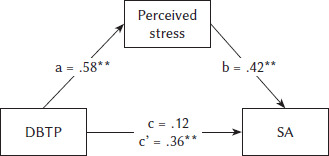
As we can see, DBTP was significantly linked to stress (β = .58, p < .001, 95% BCI = .44-.69). Stress was in turn significantly linked to smartphone addiction (β = .42, p < .001, 95% BCI = .24-.62), and the indirect effect was significant (β = .34, p < .001, 95% BCI = .14-.39), with a nonsignificant direct effect from DBTP and SA (β = .12, p = .132, 95% BCI = –.13-.35), consistent with a case of full mediation.
Having confirmed significant links to SA and stress for the summary measure of time perspective (DBTP), we performed analyses at the level of individual S-ZTPI dimensions (to trace the main sources of the effect). First, Pearson correlations between S-ZTPI dimensions and the measures of stress and SA were computed. The results are presented in Table 1, together with descriptive data (M, SD) of the measures.
Table 1
Correlations of individual S-ZTPI dimensions, perceived stress (PS) and smartphone addiction (SA), together with descriptive statistics (M, SD) of the measures
As a final step, we constructed a second mediation model with individual ZTPI dimensions as predictors of SA and, as before, with stress as a mediator. Because Present Hedonistic showed no direct association with either stress or SA, this dimension was omitted. The results are summarized in Figure 2.
Figure 2
Path model depicting the influence of S-ZTPI dimensions on smartphone addiction (SA) with perceived stress as mediator of the relationships
Note. Solid lines represent significant associations (p < .05). Values are standardized coefficients. S-ZTPI – Swedish Zimbardo Time Perspective Inventory; PP – Past Positive; PN – Past Negative; PF – Present Fatalistic; FP – Future Positive; FN – Future Negative.
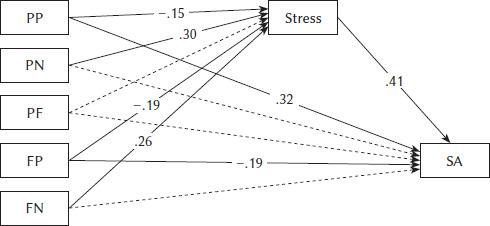
Four dimensions were significant (p < .05 or better) predictors of perceived stress. Past Negative (β = .30, p < .001) and Future Negative (β = .26, p = .002) were associated with higher levels of stress, and Past Positive (β = –.15, p = .035) and Future Positive (β = –.19, p = .006) were associated with lower levels of perceived stress. As demonstrated in previous analyses, perceived stress was in turn significantly associated with to SA (β = .41, p < .001) Moreover, the results confirmed that each of the aforementioned S-ZTPI dimensions had a significant indirect effect on SA via stress (β = .12, p = .001 for Past Negative, β = .11, p = .001 for Future Negative, β = –.06, p = .020 for Past Positive and β = –.08, p = .003 for Future Positive). Finally, Past Positive, apart from the negative indirect effect, also showed a positive direct effect (β = .32, p < .001) on SA.
One can note that adopting a more stringent alpha level to correct for multiple comparisons (e.g. dividing the customary .05 by number of ZTPI dimensions, i.e. five, to get an alpha = .01) all but two effects – i.e., the direct link from Past Positive to stress, and the indirect effect of Past Positive on SA – remained significant.
Discussion
This study explored the psychological mechanisms underlying SA in a sample of college students, with a focus on the role of time perspective, as reflected by an aggregate measure of deviations from the balanced time perspective as well as separate S-ZTPI dimensions. Also, we examined the potential role of perceived stress as a mediator of the relationship between time perspective and SA.
Deviations from the balanced time perspective (DBTP) were previously associated with psychological maladjustment and impulsive behavior (Stolarski et al., 2011; Zhang et al., 2024). The current finding that greater DBTP is associated with increased SA adds to this picture, and supports the results of the previous study by Zhang et al. (2024). In line with prior research, DBTP was furthermore strongly associated with perceived stress (Papastamatelou et al., 2015; Rönnlund et al., 2018), and, consistent with a wealth of data, stress was strongly linked to SA (Vahedi & Saipho, 2018). In line with the foregoing patterns of results, the data were furthermore consistent with the model where the influence of DBTP on SA is mediated by stress. As such, the results are not necessarily inconsistent with either of the previous studies to the extent that stress is often considered an antecedent factor of lowered self-control (cf. Pan et al., 2023) and symptoms of anxiety and depression (Zhang et al., 2024) that (partly) mediated the association between time perspective and SA in the prior studies.
Turning to the individual dimension of S-ZTPI, the bivariate analyses were consistent with results reported by Pan et al. (2023) indicating that the Past Negative and Present Fatalistic dimension were positively associated with smartphone addiction. Moreover, our results indicated that Future Positive was protective of SA (in part by reducing stress), in line with Pan et al. (2023). Importantly, our results indicate that another aspect of the future perspective, namely Future Negative, not considered in the prior studies, is critical to SA. Numerically, this was in fact the ZTPI dimension, which showed the strongest association with SA as well as with perceived stress (cf. also Rönnlund et al., 2018). This aligns with previous research suggesting that individuals who experience anxiety or feel dread about future outcomes may resort to smartphone use as a form of avoidance coping to alleviate anticipatory stress (Elhai et al., 2017; cf. Blomgren et al., 2016), and reinforces the conclusion that this dimension is important to account for variations in emotional and behavioral outcomes (Carelli et al., 2011; Stolarski & Matthews, 2016).
Somewhat surprisingly, our results indicated that, apart from a negative influence via stress, Past Positive has a positive direct effect on SA. As such, this seems to contradict the assumption that a warm and positive attitude toward one’s past is always psychologically adaptive, as reflected by the results of many prior studies, linking this dimension to, for example, greater self-esteem (Zimbardo & Boyd, 1999), reduced risk of depressive symptoms (Åström et al., 2019) and feeling less lonely during the COVID-19 pandemic (Nowakowska, 2020). A possible explanation of the current finding is that students high in past-positive attitudes may be more likely to engage in nostalgic content – such as reviewing old messages, posts or photos. In fact, such reminiscence of digital stored memories (digital nostalgia) has become an important part of social media platforms (Jungselius & Weilenmann, 2023). These platforms actively promote it, for example by reminding users of content shared by themselves and other users (e.g., “memory from today, five years ago”). While not necessarily pathological and potentially promoting wellbeing (cf. Li et al., 2023), use of smartphones and social media to engage in reminiscence and nostalgic content could possibly contribute to increased screen time and in the worst case be addictive.
The present study has several limitations. First, the study design was cross-sectional, a design where the hypothesized causal directionality among study variables cannot be firmly established but can only be used to evaluate whether hypothetical causal models (e.g., mediation models) are plausible. Second, the gender distribution in our sample was skewed (75% females), which could potentially bias the results. There is evidence that SA broken down into types of addiction may be differentially related to stress in women and men, with a stronger association of stress and social media use in women than men, whereas the opposite pattern is observed for gaming and short video addiction (Tu et al., 2023). Thus, future studies should take into account potential moderating influences of gender on the results. Third, this study, consistent with prior studies examining associations of time perspective and SA (Pan et al., 2023; Zhang et al., 2024), involved a Chinese study sample, in our case from a single city. Consequently, generalizability to samples from other cultural settings and demographic settings needs to be demonstrated by future studies. To address the limitations of the current study, future research should ideally employ longitudinal designs to explore the causal relationships among the variables and evaluate the effectiveness of interventions tailored to different time perspective profiles and be conducted across multiple and cultural and demographic settings. Incorporating behavioral tracking data (e.g., screen time logs) could provide more objective insights into the interplay between psychological constructs and smartphone use.
In conclusion, our findings underscore that time perspective is a key factor in SA that may influence behavioral addiction through its impact on stress. From a practical point of view, these results suggest that interventions targeting smartphone addiction should focus not only on reducing screen time but also on enhancing time orientation and stress management skills. Specifically, interventions aimed at reducing future negative thinking and rumination on past negative experiences could be particularly effective. Mindfulness-based interventions show promise in this regard, as they have been found to lower DBTP and reduce stress (Rönnlund et al., 2019; Stolarski et al., 2016).