
BACKGROUND
Negative stereotypes about depression are more prevalent than those associated with other mental disorders (Day et al., 2007). Thus, this study focuses on personal depression stigma (PDS; Griffiths et al., 2004), also referred to as public stigma (Corrigan & Watson, 2002) which involves negative views of people with depression, including the belief that they are responsible for their illness (Griffiths et al., 2004; Cook & Wang, 2010). Despite numerous anti-stigma campaigns, depression stigma remains widespread (Schnyder et al., 2017), underscoring the need to identify psychological predictors that can inform prevention. While previous research focused on the role of demographic characteristics in relation to PDS (e.g., Foster & O’Mealey, 2021), research into the individual psychological factors as potential predictors of PDS is scarce. To our knowledge, need for cognitive closure (NCC) as a personality trait, as well as materialistic goals, has never been studied before in relation to PDS. NCC – a motivational tendency to prefer order, predictability, and clear answers – is associated with higher materialistic values, possibly as a strategy to reduce existential or epistemic uncertainty, underpinning stigmatizing attitudes (Roets & Van Hiel, 2011a). On the other hand, individuals facing uncertainty often adopt materialistic orientations as a coping mechanism (Chang & Arkin, 2002). Consequently, NCC and materialism seem to share an underlying orientation toward control. Thus, the joint investigation of these two concepts as relevant predictors which might reinforce each other in the context of depression stigma is theoretically justified.
SOCIOECONOMIC AND DEMOGRAPHIC FACTORS IN RELATION TO DEPRESSION STIGMATIZATION
Previous research suggests a complex relationship between socioeconomic status (SES) and depression stigma. A cross-European study found a significant association between lower SES and increased odds of depression, with education playing a more significant role than income (Freeman et al., 2016). High-SES individuals are more likely to attribute mental illness to internal, controllable factors, which leads to blaming the individual for its onset (Foster & O’Mealey, 2021). Regarding gender, while some studies have reported a higher PDS in women compared to men (Grant et al., 2016), the opposite result was also observed (Griffiths et al., 2008). Also, studies found that greater contact with and knowledge of depression predicted lower PDS (Grant et al., 2016; Griffiths et al., 2008). Additionally, since stigma-related mental health challenges differ across countries (Grant et al., 2016), Romania and Moldova remain underrepresented in research. In Moldova, a national survey found a 19.8% prevalence of significant depressive symptoms, while Romania reports one of the lowest depression rates in Europe – though underreporting due to stigma and healthcare barriers is likely (OECD & European Observatory on Health Systems and Policies, 2023; van Baar et al., 2025). Studies show that in Moldova, medical students perceive more societal stigma than PDS (Eșanu, 2023). In Romania, public stigma outweighs self-stigma, influenced by media and institutions (Mănescu et al., 2023). Examining both countries provides insight into how PDS manifests in culturally and historically similar Eastern European contexts. Relying on the arguments described above, we formulated Hypothesis 1 (H1): Demographic factors and level of contact with depression correlate with PDS.
THE ROLE OF NEED FOR COGNITIVE CLOSURE IN PERSONAL DEPRESSION STIGMATIZATION
Although demographic variables have been explored, there is limited research on other potential predictors of PDS. Openness to experience appears to reduce prejudicial attitudes toward stigmatized groups (Jonáš et al., 2023), while individuals lacking complete beliefs about illness often rely on partial explanations shaped by personal and social experiences (Walsh & Foster, 2021). Therefore, those high in openness may seek out exploratory information, whereas individuals with a high need for cognitive closure (NCC) favor quick and decisive processing. The NCC is a stable trait (Fortier & Burkell, 2014) that influences one’s cognitions, including intergroup attitudes and explains inter-individual variations in information behavior (Kruglanski et al., 2018). Since individuals exhibiting high NCC prefer predictability and stable knowledge (Roets et al., 2015), the low success of anti-stigma campaigns might be understood by the fact that people with high NCC are reluctant to change their prior opinions when facing new information (Nisbet et al., 2013). Based on the arguments presented above, we proposed Hypothesis 2 (H2): Need for cognitive closure is positively correlated with PDS.
NEED FOR COGNITIVE CLOSURE AS A MODERATOR IN THE RELATIONSHIP BETWEEN LEVEL OF CONTACT WITH DEPRESSION (CWD) AND PDS
More interaction with mental health issues was associated with decreased personal stigma concerning anxiety and depression (Grant et al., 2016). Similarly, both close and non-close contact was correlated with a more favorable perception of mental illness (Yuan et al., 2018). At the same time, individuals who show more stigmatizing attitudes have lower scores on openness to experience while those with higher scores exhibit cooperative behaviors (Yuan et al., 2018). Expanding on the relationship between personality traits and stigma, individuals with a high NCC tend to exhibit increased stereotyping, while those with low NCC tend to have reduced stereotyping (Sun et al., 2016). Thus, the research question that arises is: Does the influence of contact with depression (CwD) on PDS depend on how much someone has a need for cognitive closure? It is to be expected that for people high in NCC who are resistant to change, less CwD will have a different impact on PDS than in the case of low NCC because they may cling to stereotypes despite experience. The study intends to fill an existing gap in the literature, triggered by a limited integration of personality traits and social variables for explaining depression stigmatization. Consequently, we formulated Hypothesis 3 (H3): NCC moderates the relationship between CwD and PDS.
MATERIALISM AND PERSONAL STIGMA AGAINST DEPRESSION
Goal contents theory (GCT; Kasser & Ryan, 1996; Kasser et al., 2014) explains the link between materialistic values and PDS by distinguishing intrinsic from extrinsic goals. Materialism has been viewed as both a personality trait (Belk, 1985) and a value system in consumer behavior (Kasser et al., 2014) and is now often defined by the extent to which individuals use products to shape their identity (Shrum et al., 2013). In capitalist societies, the “ideal person” is seen as a producer (Grinker, 2021). Research shows that higher materialism in youth correlates with greater self-stigmatization, partly through social media use (Bible et al., 2021). The What Matters Most (WMM) framework (Yang et al., 2007) supports this, suggesting that stigma is strongest when mental illness threatens culturally valued goals. According to the WMM approach, individuals who prioritize achievement-oriented values may respond to depression with heightened stigma, as the illness represents a disruption of WMM to them (Yang et al., 2007). As an unexplored field, understanding this link can help us create effective anti-stigma solutions for people suffering from depressive disorder who face judgment from materialistic people. Therefore, in alignment with the mentioned theoretical framework, we proposed Hypothesis 4 (H4): Materialism positively correlates with personal depression stigma.
THE CURRENT STUDY
The first aim of this study was to test a predictive model of PDS by combining established SES and demographic factors with two less explored psychological variables: NCC and materialism. NCC, linked to discomfort with ambiguity, may promote rigid, stigmatizing views of mental illness, while materialism, associated with lower empathy and higher social comparison, may also reinforce stigma toward depression. Three correlational hypotheses using hierarchical regression were proposed: (1) demographic factors predict PDS; (2) NCC adds to this prediction beyond demographics and CwD; and (3) materialism further predicts PDS beyond all other variables. The second objective was to examine whether the relationship between NCC and stigmatizing beliefs varies by individuals’ prior CwD.
PARTICIPANTS AND PROCEDURE
PARTICIPANTS
The study was conducted in Romania and the Republic of Moldova among a convenience sample aged 16-62. The total sample was 224 (Mage = 27.21, SDage = 9.73). The number of Romanian respondents was 111 (49.6%). The male gender was underrepresented for the whole sample (n = 48, 21.4%). The percentage completing higher education was 54.02%, while the rest of the respondents had completed secondary education. A detailed description of the sample from a socio-demographic perspective is presented in Appendix 1 in Supplementary materials.
PROCEDURE
Participants were recruited through online snowball sampling. A link to the questionnaire was shared via social media networks and through personal email contacts between January 21 and July 23, 2024. Participants were also asked to send links to the study to their acquaintances. Data were collected using Google Forms. All responses were compulsory; no missing data were recorded. Respondents completed a set of scales and answered several questions regarding nationality, age, gender, SES, education, and environment of origin. Before the first section of questions, the purpose of the study and ethical aspects relevant to the informed consent were explained.
MEASURES
The participants from both countries completed the questionnaire in Romanian language.
Contact with depression (CwD) was measured with the Level of Contact Report (Holmes et al., 1999), in the modified version to target depression (Griffiths et al., 2008), which lists 12 situations that participants have experienced in their lifetime. The items were translated into Romanian and back translated into English to assess the quality of the translation by two independent and certificated translators. The index for contact was the rank score of the most intimate situation indicated by the participant. For example, a person who checked “Relative has depression” (rank order score = 10) and “Have watched movie/TV depicting a person with depression” (rank order score = 3), would receive a score of 10 because “Relative has depression” is the most intimate of the checked situations.
Personal depression stigma (PDS) was measured with the corresponding scale from Personal and Perceived scales of the Depression Stigma Scale (DSS; Griffiths et al., 2008), which comprises 9 items rated on a 5-point Likert scale ranging from 0 (strongly disagree) to 4 (strongly agree). An item example is: “Depression is not a real medical illness.” The scale has been previously translated in Romanian language and used in Moldova, demonstrating reliable psychometric coefficients (Esanu et al., 2020). For the current sample, we performed a confirmatory factor analysis (CFA) for each country, and then a multiple-group confirmatory factor analysis (MG-CFA) using AMOS 26. The results showed a good fit of the one-factor model for each country sample. The measurement invariance analysis revealed that the scale can be validly applied across the two countries. Statistical indicators are presented in Appendix 2 in Supplementary materials. In the present study, the Cronbach’s α coefficient of .80 further supports the scale’s reliability.
Need for cognitive closure (NCC) was measured with the short version of the Need for Cognitive Closure Scale (NCCS) developed by Webster and Kruglanski (1994) and updated by Roets and Van Hiel (2011b). As there were no Romanian versions of this measure, we performed a back-translation procedure. The scale comprises 15 items. An item example is: “I dislike questions which could be answered in many different ways.” Respondents were asked to rate their answers on a Likert scale, from 1 (strongly disagree) to 6 (strongly agree). In terms of construct validity, CFA revealed acceptable fit measures for Romania and good fit measures for Moldova. The measurement invariance analyses confirmed that the NCCS can be validly applied across both countries. The results are described in Appendix 2 in Supplementary materials. In the present study, the scale showed a high internal consistency (Cronbach’s α = .85), supporting its reliability in our sample.
Materialism was assessed with three scales from the Aspiration Index (Kasser & Ryan, 1996; Kasser, 2019). The statements refer to three materialistic goals or extrinsic values: financial success (e.g., “You will have a lot of expensive possessions”), attractive appearance (e.g., “You will have people comment often about how attractive you look”), and social recognition (e.g., “Your name will be known by many people”). Respondents are asked to answer, “How important is this goal to you?”, and the responses are measured on a Likert scale from 1 (not at all important) to 7 (extremely important). The Romanian version translation equivalence of the Aspiration Index was established in prior research (Stevens et al., 2006). Furthermore, the scale has previously been employed in Romanian research, where it demonstrated strong psychometric properties, with Cronbach’s α values for the materialistic subscales ranging from .79 to .91 (Eniko & Stefan, 2016; Stevens et al., 2011). In the current study, the scale had excellent reliability measured through internal consistency with Cronbach’s α = .92. The statistical indices for CFA and MG-CFA calculated for materialism as a single construct are reported in Appendix 2 in Supplementary materials.
DATA ANALYSIS
Statistical analysis was performed in SPSS 23.0. The correlations among all variables are presented in Appendix 3 in Supplementary materials. The analysis revealed positive correlations of PDS with age, NCC, and materialism. Additionally, PDS was negatively correlated with the level of exposure to depression (r = –.20, p < .001). The correlation with SES was not statistically significant. Comparisons between categorial variables (country, educational level, gender, and environment of origin) regarding PDS are described in Appendix 4 in Supplementary materials. Gender showed a significant difference for depression stigmatization, with higher scores for men (M = 22.12, SD = 8.91) than for women (M = 18.43, SD = 5.73). There were no significant differences between countries, educational level, and environment of origin. Thus, the first hypothesis was partially confirmed. Age and level of exposure to depression correlate with depression stigmatization. The older people are, the more they tend to stigmatize. On the other hand, higher exposure to depression negatively correlates with PDS. Also, male gender is a factor that predisposes to PDS. However, unlike the results of other studies, SES, educational level, and environment of origin did not show associations with PDS in the present sample. This could be explained by the nature of the sample – a convenient one in which data might be prone to bias related to the above-mentioned variables.
Further, a hierarchical multilinear regression analysis where PDS was introduced as a dependent variable was performed to test the hypotheses. For statistical consistency, demographic variables that do not correlate with depression stigma were not included in the regression models. As no statistically significant differences were observed between the two countries in terms of depression stigmatization, level of CwD, NCC, and extrinsic goals, and tests confirmed measurement invariance, data were pooled for subsequent analyses. However, countries of origin were included in the regression models as a control variable. Based on the theoretical and empirical arguments, country, age, gender, level of exposure to depression, NCC, and extrinsic goals were introduced as predictor variables in the first step. NCC was introduced in the second step because it was hypothesized to be an unexplored personality trait, impacting depression stigmatization. After controlling for the influence of the country, age, gender, level of exposure to depression, and NCC, extrinsic goals were introduced in the third step as part of an individual’s value system which expresses materialistic orientation. The regression analysis was performed in SPSS 23.0.
Table 1 shows the results of the regression analysis. Age, gender, and exposure to depression explained 10% of variance of PDS in the first step (F(3, 220) = 8.71, p < .001) but age was not a significant predictor. These results partially support Hypothesis 1, which states that demographic factors and level of CwD correlate with PDS. Male gender correlates positively with PDS while previous CwD represents a negative predictor. Furthermore, NCC added in the second step was a significant predictor of PDS, explaining an additional 2% of variance (F(4, 219) = 8.33, p = .012), over and above CwD and gender belonging. These results supported Hypothesis 2, which states that NCC is positively correlated with PDS. In the third step, materialism significantly predicted PDS, explaining 32% of the variance in this outcome. It accounted for an additional 9% of the variance compared to the second model (F(5, 218) = 12.57, p < .001). Hence, the third hypothesis, which stated that materialism is positively correlated with PDS (H3), received empirical support. Male gender and the level of CwD remained significant predictors, age became a significant predictor (β = .18, p = .005), while the NCC became non-significant in this step. The introduction of materialism as a personal value in this step increased the explanatory power over previous models by 9% (ΔR2 = .09; F(5, 218) = 12.57, p < .001), and is the stronger predictor of this model, which explores antecedents of PDS (β = .32, p < .001).
Table 1
Summary of hierarchical regression models predicting depression stigmatization
The comparative analysis of the three proposed models as presented in Table 2 indicates that model 3, which includes demographic variables, NCC, and extrinsic values, best explains the scoring variant in terms of PDS. In this last model, the strongest predictor for PDS turns out to be extrinsic goals (32%), followed by male gender (21%). Age and depression exposure have similar relative predictive power (18% and 17%).
Table 2
Summary of model fit measure and model comparisons (N = 224)
| Model | R | R2 | Adjusted R2 | ΔR2 | p | F | p |
|---|---|---|---|---|---|---|---|
| 1 | .32 | .10 | .09 | .10 | < .001 | 6.52 | < .001 |
| 2 | .36 | .13 | .11 | .02 | .012 | 6.64 | < .001 |
| 3 | .47 | .22 | .20 | .09 | < .001 | 10.44 | < .001 |
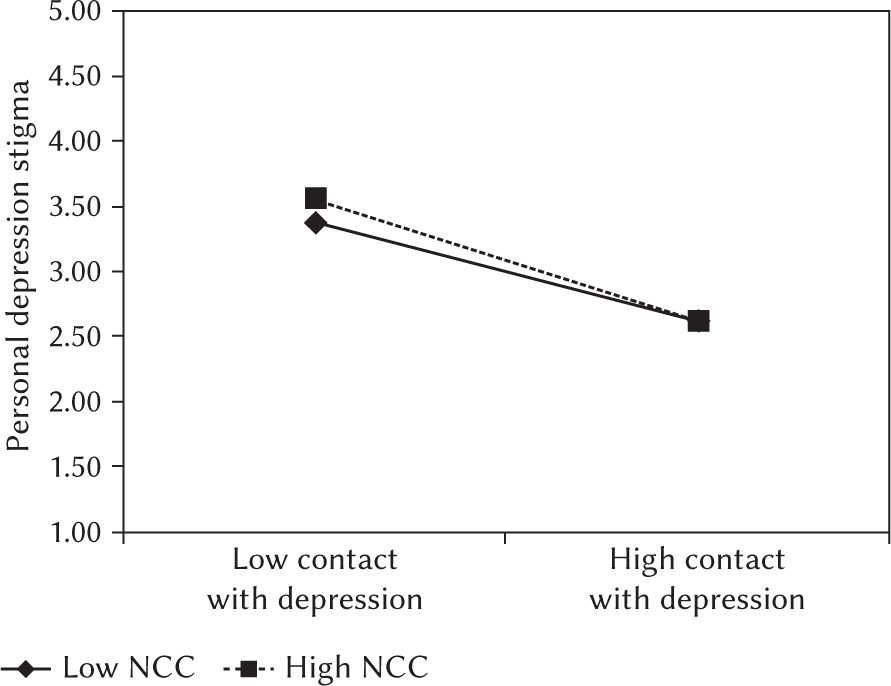
Finally, the moderation effects of NCC in the relationship between CwD and PDS (H4) were tested using the PROCESS macro for the SPSS v23 program, Model 1 (Hayes, 2017). The results can be found in Table 3. The data show empirical support for hypothesis H4. The NCC moderates the impact of CwD on PDS (ΔR2 = .02, p = .017).
Table 3
Results of moderated analysis of need for cognitive closure in the relationship between level of contact with depression and personal depression stigma (PROCESS)
| Independent variables | β | SE | t | F | ΔR2 |
|---|---|---|---|---|---|
| Contact with depression (X) | –.38** | .11 | –3.23 | ||
| Need for cognitive closure (W) | .09** | .03 | 2.74 | ||
| Contact with depression × Need for cognitive closure | –.02* | .00 | –2.39 | 5.72 | .02* |
As shown in the simple slope chart in Figure 1, when the CwD is low, people with a higher NCC reach a higher level of PDS than people with a lower NCC.
DISCUSSION
The results confirmed the main hypotheses that PDS is influenced by various factors, including gender, level of CwD, NCC, and extrinsic aspirations. Within these results, the moderating role of the NCC in the relationship between level of CwD and PDS is noted, but also the significant association between depression stigma and materialism over and above all other variables. Regarding the result which confirms the role of male gender, Romania and Moldova are traditional orientated societies, with men adhering to proscriptive masculine roles (Kaser, 2021; Rusu, 2023). According to our results, the endorsement of masculine roles triggers the negative perception of depression. These findings suggest that rigid adherence to traditional gender roles, particularly masculine norms, may negatively impact PDS, while more flexible gender role orientations may be protective. Furthermore, like previous research (Griffiths et al., 2008), our study confirmed that close CwD predicted lower PDS, but our results extended the nature of this relationship, revealing the moderator role of NCC. The results point to the fact that when individuals experience minimal CwD, those who possess a greater NCC exhibit a higher degree of PDS compared to those with lesser NCC. Interventions should assume that more CwD reduces stigma, but at the same time, it accounts for how cognitive traits may resist attitude change. The results will contribute to understanding why some individuals remain stigmatized despite personal or professional exposure to depression and can help healthcare professionals in tailoring anti-stigma campaigns for increased success. Finally, the most obvious result emphasizes that materialistic values predict the stigmatization of depression over and above all other variables. When materialism is added to the model, the predictive power of NCC disappears. This might be because materialism may account for the same psychological mechanisms as NCC. Materialism may capture or explain the same rigid, control-focused worldview that NCC does. If materialism is more directly related to attitudes toward depression, then when both are in the model, materialism “absorbs” the predictive power. Our results support the basic assumptions of the goal content theory that when people are focused on external goals, they are less connected with their peers. Since CwD remains a significant predictor in all the models tested, we can conclude that there is substantial evidence demonstrating that people who place relatively high priority on extrinsic or materialistic goals have superficial interpersonal relationships (Kasser, 2016), even in the presence of close CwD.
The results of this study suggest some practical recommendations, indicating that tolerance-of-ambiguity training for individuals with high NCC can help them become more comfortable with uncertainty (e.g., exposure to ambiguous scenarios, structured role play or empathy-building activities where participants reflect on the lived experiences of people with depression). Additionally, social comparison theory (Festinger, 1954) offers a rationale for using public figures and targeted messaging to reach highly materialistic individuals. People often gauge what is acceptable or desirable by comparing themselves with others, especially those they aspire to emulate. Thus, seeing high-status role models discuss mental health can shift societal norms around wealth and well-being. Targeting both value system (materialism) and cognitive style (NCC) with psychological, educational, and experiential interventions may reduce depression stigma and foster more accepting communities.
LIMITATIONS AND FUTURE DIRECTIONS
The current study has several significant limitations. First, it was correlational, meaning that causal relationships between variables could not be determined. Second, there is the issue of social desirability, which can influence respondents by distorting responses towards positive self-presentation. Third, convenience samples are often criticized for limited generalizability. However, regression can still yield valid estimates of relationships if the model is well specified and measurement instruments are reliable and valid (Bornstein et al., 2013). Multicollinearity diagnostics and sensitivity analyses that were conducted, as well as the reliability and validity of the instruments used, help mitigate the limitations of using hierarchical regression on a non-probabilistic sample. Another limitation is the gender imbalance, as male respondents represent less than 20% of the total sample. Furthermore, pooling data from two countries involves several important limitations. Although we found no significant differences between the countries, pooling is considered acceptable if measured variables have the same meaning across countries (Davidov et al., 2018). Thus, the questionnaire was applied in Romanian language in both countries, while the study design, sampling method, and data collection procedures are comparable across countries (Van de Schoot et al., 2012). Moreover, the sample sizes are similar, and no significant interaction effects between the country and key independent variables were found, suggesting that the relationship between variables is consistent across countries. Finally, except for the materialism measurement, the results for the measurement invariance analysis revealed that the scales can be validly applied across the two countries. For more robust conclusions it would be useful to expand the sample to include diverse and representative populations, in both Romania and Moldova. Also, because materialism as measured by the Aspiration Index (Kasser & Ryan, 1996; Kasser, 2019) is a multidimensional factor, a scale that assesses materialism as one-dimension construct is recommended.
The strength of this study lies in the fact that it is the first research to explore the relationship between PDS, NCC, and extrinsic aspirations. Confirming the hypotheses may provide a starting point for further exploration of the topic of PDS and human aspirations. The results can also be used to develop and implement anti-stigma solutions, focusing on psychological factors.
CONCLUSIONS
Exploring psychological factors involved in PDS is crucial due to its impact on anti-stigma campaigns. This is the first research indicating that PDS is influenced by various psychological risk factors such as materialism as a value orientation or NCC as a personality trait. This research extends existing knowledge related to predictors of PDS and offers essential insights for practitioners seeking to develop effective interventions aimed at reducing public stigma surrounding depression.
Supplementary materials are available on the journal’s website.