BACKGROUND
Emotional eating (EE) refers to food consumption in response to emotions, not physiological hunger, with prevalence rates ranging from 20% in community samples to 40% in samples with obesity (Elran Barak et al., 2021; Kidwell et al., 2024). Rates in non-Western or culturally diverse samples may differ (e.g., Sze et al., 2021). EE is a complex behavior associated with many factors, including female gender, body mass index (BMI), and stress (Elran Barak et al., 2021; Kidwell et al., 2024; Sze et al., 2021). Although common, EE has been related to health problems, such as heart disease and depression (Dakanalis et al., 2023). Considering its negative effects on well-being, understanding its mechanisms is important.
Many individuals who engage in EE eat when they feel negative emotions and use eating as a temporary way to manage and alleviate them (Frayn & Knäuper, 2018). Emotional eaters generally prefer sweet or high-fat foods, which are thought to activate the brain’s reward systems and provide a positive emotional experience (Schepers & Markus, 2015). Eating is assumed to provide a temporary escape and shift one’s attention away from negative emotional experiences (Heatherton & Baumeister, 1991). Despite its regulatory function on emotions, EE may become a habitual coping mechanism, promoting weight gain (Frayn & Knäuper, 2018).
EE has been consistently linked to difficulties in emotion regulation (ER) and the use of less adaptive ER strategies, such as rumination, suppression, and avoidance (Evers et al., 2010; Prefit et al., 2019). Even though research on EE and ER exists, we know less about how dysfunctional emotion beliefs (EB) relate to EE.
BELIEFS ABOUT EMOTIONS AND EE
How individuals perceive and interpret their emotions may affect their tendency to eat in response to negative emotions. EB involve perceptions of whether emotions can be controlled and changed, and whether they serve a useful purpose (Ford & Gross, 2019). Specifically, controllability beliefs refer to whether emotions are controllable versus uncontrollable (e.g., “positive emotions cannot be changed”). Usefulness beliefs refer to whether emotions are useful versus useless (e.g., “negative emotions have no use”). Dysfunctional EB have been linked to negative emotionality in response to daily stressors, less adaptive ER strategies, and poor ER skills (e.g., Ford & Gross, 2019; Kneeland & Dovidio, 2020).
Despite the role of EB in ER and previous evidence on ER difficulties in eating pathology (Prefit et al., 2019), there is limited research on the link between EB and eating. Studies have indicated that dysfunctional EB, such as the belief that emotions are uncontrollable, are related to eating disorders (EDs), through the use of less adaptive ER strategies (e.g., Vuillier et al., 2021). Yet, these studies did not focus on EE. Among the few studies that did so, Strodl and Wylie (2020) and Strodl and Sorensen (2023) found a positive association between dysfunctional EB and eating in response to negative emotions. Therefore, initial evidence suggests that EB and EE are related. To our knowledge, no prior studies have examined potential mechanisms underlying the association between EB and EE. In this study, we focused on rumination, which has been consistently linked to disordered eating (Smith et al., 2018), to explain how dysfunctional EB relates to EE.
THE ROLE OF RUMINATION AS A MEDIATOR
Believing that negative emotions are uncontrollable or useless may promote a cognitive process known as rumination. Rumination is characterized by a repetitive and passive focus on one’s problems and negative emotions, often to understand their possible causes and consequences (Nolen-Hoeksema, 1991). Rumination increases negative affect, hinders effective ER and problem-solving (Lyubomirsky & Tkach, 2003), and is linked to the initiation and maintenance of EDs (Prefit et al., 2019; Smith et al., 2018).
Research suggests that EB may influence individuals’ use of rumination to regulate emotions. For example, first-year university students who initially believed that emotions can be changed had lower scores on rumination and depression at the end of the semester (Kneeland & Dovidio, 2020). A recent meta-analysis on controllability beliefs and rumination also found a relatively weak, but significant, negative association between them (Kim et al., 2024). Overall, evidence indicates a positive association between the belief that emotions are uncontrollable and rumination, suggesting that rumination might be an attempt to understand and manage negative emotions when they are perceived as uncontrollable. Studies focusing on the association between usefulness beliefs and rumination are scarce, yet existing research demonstrates their common links to the non-acceptance of emotions (e.g., Karnaze & Levine, 2020). Individuals who believe that negative emotions are useless or bad may perceive them as aversive, which could promote greater rumination as a maladaptive ER strategy. However, more research is needed to explore this association.
Rumination is also associated with EE. For example, Kubiak and colleagues (2008) found that rumination on daily stressors predicted the desire to eat, while ecological momentary assessment studies confirmed that rumination predicts EE (Kornacka et al., 2021). Eating may create a shift away from distressing negative thoughts, providing a temporary escape (Heatherton & Baumeister, 1991). Furthermore, EE can be a reaction to heightened negative affect due to rumination. Dysregulated behaviors such as EE may provide short-term relief or distraction from the cascade of rumination and negative affect (Selby et al., 2008). These results suggest that rumination is associated with both EB and EE, and might act as a mechanism between them.
THE PRESENT STUDY
This study aimed to examine how beliefs about the controllability and usefulness of negative emotions relate to EE, with a focus on rumination as a mediator. Despite numerous studies on ER and EDs, few have addressed the association between EB and EE (Evers et al., 2010). Based on preliminary findings, EB may be a mechanism in the initiation and maintenance of EE, through their effects on less adaptive ER strategies such as rumination. To our knowledge, no previous studies have tested the role of rumination as a mechanism between EB and EE, a gap this study intended to address. By identifying these mechanisms, the present study could provide valuable insights for developing targeted interventions to reduce EE. Understanding EE may help target everyday maladaptive eating before the development of more severely disordered eating behaviors.
We hypothesized that rumination would mediate the relationship between the belief that negative emotions are uncontrollable and useless, and EE. Moreover, as an exploratory hypothesis, we wanted to explore whether BMI moderates the association between EB and EE, as well as between rumination and EE. Research suggests that EE is more common in overweight and obese individuals (Reichenberger et al., 2021), and higher BMI has been positively associated with eating in response to negative emotions (Meule et al., 2018). Additionally, individuals with higher BMI often show inhibitory control deficits and ER difficulties (e.g., Lavagnino et al., 2016). Accordingly, we wanted to explore whether the strength or direction of the association between EB and EE, and rumination and EE, would vary based on levels of BMI.
PARTICIPANTS AND PROCEDURE
PARTICIPANTS
The sample consisted of 414 Turkish adults (296 female, 71.5%; 116 male, 28%; 2 unspecified, 0.5%). The ages ranged from 18 to 75 (M = 32.5, SD = 11.43). Most of the participants were university (46.4%) or high school graduates (28%). The majority of the sample identified themselves as belonging to the middle (51.4%) or upper-middle (31.4%) socio-economic status (SES). As for BMI, 27 individuals (6.5%) were classified as underweight (BMI < 18.5), 234 individuals (56.5%) as normal weight (BMI 18.5-24.9), 106 individuals (25.6%) as overweight (BMI 25-29.9), and 47 individuals (11.4%) as obese (BMI ≥ 30) (World Health Organization, 2000). Regarding psychiatric history, most of the participants (n = 347; 83.8%) reported no lifetime psychiatric diagnosis or treatment.
MATERIALS
The Emotion Beliefs Questionnaire (EBQ). The EBQ is a self-report questionnaire developed by Becerra et al. (2020) to measure individuals’ perceptions of controllability (e.g., “People cannot control their positive emotions”) and usefulness (e.g., “Negative emotions are harmful”) of positive and negative emotions. The questionnaire has 16 items rated on a 7-point Likert-type scale from 1 (strongly disagree) to 7 (strongly agree), where higher scores indicate stronger dysfunctional beliefs. The EBQ consists of four subscales: negative/positive controllability and negative/positive usefulness. The Turkish adaptation of the EBQ was developed by Tuna (2025). In this study, only the negative controllability and usefulness subscales were used to assess EB, because EE primarily occurs in response to negative emotions, and rumination reflects repetitive thinking about negative emotions.
The Ruminative Response Scale (RRS) Short Form. The abbreviated version of the RRS (Treynor et al., 2003) measures individuals’ tendency to engage in rumination using two 5-item subscales: brooding and reflection. Items are rated on a 4-point Likert-type scale from 1 (almost never) to 4 (almost always). The scale has been adapted into Turkish by Erdur-Baker and Bugay (2012). In this study, we used the brooding subscale (e.g., “Why do I always react this way?”) because brooding reflects a relatively more maladaptive dimension of rumination, with stronger links to eating pathology (e.g. Dondzillo et al., 2016).
The Dutch Eating Behavior Questionnaire (DEBQ). The DEBQ is a self-report questionnaire that examines eating behaviors using 33 items divided into three subscales: dietary restraint, EE, and external eating (van Strien et al., 1986). Respondents use a 5-point Likert-type scale, ranging from 1 (never) to 5 (very often) to rate the items, and higher scores reflect an increased tendency to engage in the corresponding eating behavior. Bozan et al. (2011) adapted the DEBQ into Turkish. In this study, the EE subscale consisting of 13 items was used (e.g., “Do you have a desire to eat when something unpleasant is about to happen?”).
Demographic information form. Participants completed a demographic information form to report on their age, gender, education, perceived SES, presence of lifetime psychiatric diagnosis and treatment, and self-reported weight and height. BMI was calculated by dividing weight by height squared.
PROCEDURE
The institution’s Social Sciences and Humanities Ethics Committee approved the study. Participants were recruited online through convenience sampling, and informed consent was obtained before data collection. Participation was voluntary. Data were collected online via Google Forms.
DATA ANALYSIS
Initially, descriptive statistics and Pearson’s correlation coefficients were calculated. Then, two simple mediation analyses were conducted to test whether rumination mediated the relationship between controllability and usefulness beliefs and EE. Mediation analyses were performed using the PROCESS macro for SPSS Version 21, Model 4. Next, BMI was included in these models to examine whether it moderated the associations between EB and EE, and rumination and EE. We used the PROCESS macro, Model 15 for these analyses. Because there were relatively small numbers of participants in the underweight and obese categories, BMI scores were represented in two groups to maximize statistical power: underweight and normal weight (BMI < 25), and overweight and obese (BMI ≥ 25), following previous studies (e.g., Graham et al., 2011; Petursdottir Maack et al., 2019). Gender was included as a covariate, given the positive association between being female and EE (Elran Barak, 2021).
RESULTS
Descriptive statistics and Pearson correlation coefficients are presented in Table 1. Perceiving negative emotions as uncontrollable or useless was positively correlated with rumination, but not with EE. Rumination was positively related to EE. Finally, participants’ BMI correlated positively with both controllability and usefulness beliefs, and with EE, but not rumination.
Table 1
Means, standard deviations, Cronbach’s alphas, and correlations among emotion beliefs, rumination, emotional eating, and BMI
| 1 | 2 | 3 | 4 | 5 | |
|---|---|---|---|---|---|
| 1. EBQ-NC | 1 | ||||
| 2. EBQ-NU | .47*** | 1 | |||
| 3. DEBQ-EE | .09 | .01 | 1 | ||
| 4. RRS-B | .37*** | .18*** | .28*** | 1 | |
| 5. BMI | .13* | .16** | .26*** | .03 | 1 |
| M | 8.75 | 10.90 | 33.40 | 11.60 | 24.30 |
| SD | 4.54 | 5.50 | 15.60 | 3.40 | 4.79 |
| α | .76 | .75 | .97 | .75 | – |
[i] Note. *p < .05, **p < .01, ***p < .001. EBQ-NC – Emotion Beliefs Questionnaire-Negative Controllability; EBQ-NU – Emotion Beliefs Questionnaire-Negative Usefulness; DEBQ-EE – The Dutch Eating Behavior Questionnaire-Emotional Eating; RRS-B – Ruminative Responses Scale-Brooding; BMI – body mass index.
The first mediation analysis examined the role of rumination in the association between controllability beliefs and EE (Figure 1). The model explained 9% of the variance (R2 = .09). Controllability beliefs were significantly associated with rumination (a path; B = 0.28, SE = 0.03, t = 8.14, p < .001). Rumination was significantly associated with EE (b path; B = 1.23, SE = 0.24, t = 5.16, p < .001). There was a significant indirect effect of controllability beliefs on EE through rumination (ab path); B = 0.34, 95% CI [.190, .511]. The total effect (c path; B = 0.31, SE = 0.17, t = 1.86, p = .060) and the direct effect (c’ path; B = –0.03, SE = 0.18, t = –0.15, p = .884) of controllability beliefs on EE were not significant. Therefore, EB were related to EE only indirectly through rumination.
Figure 1
Mediational models of rumination linking emotion beliefs and emotional eating
Note. Unstandardized regression coefficients are reported; *p < .001.
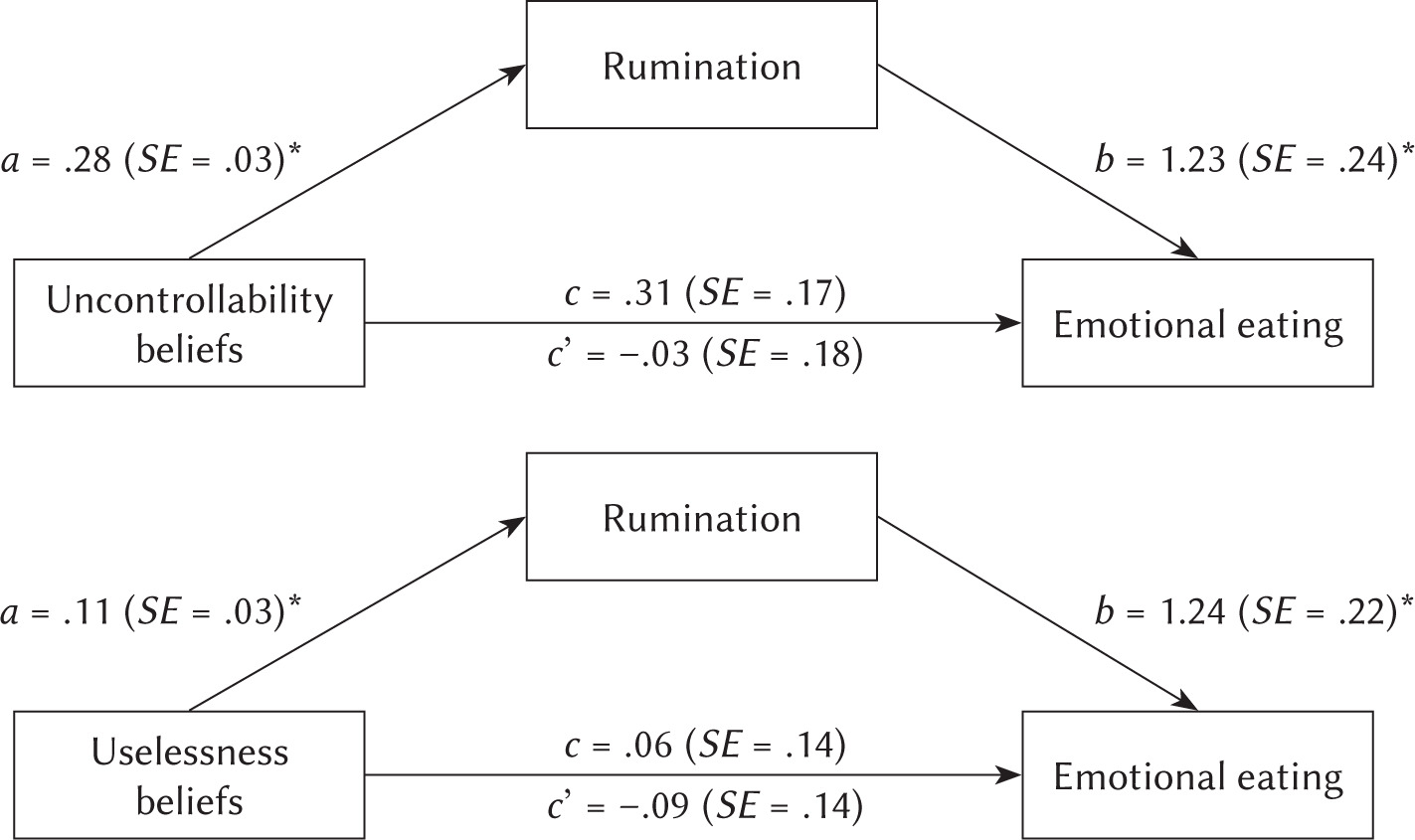
Figure 2
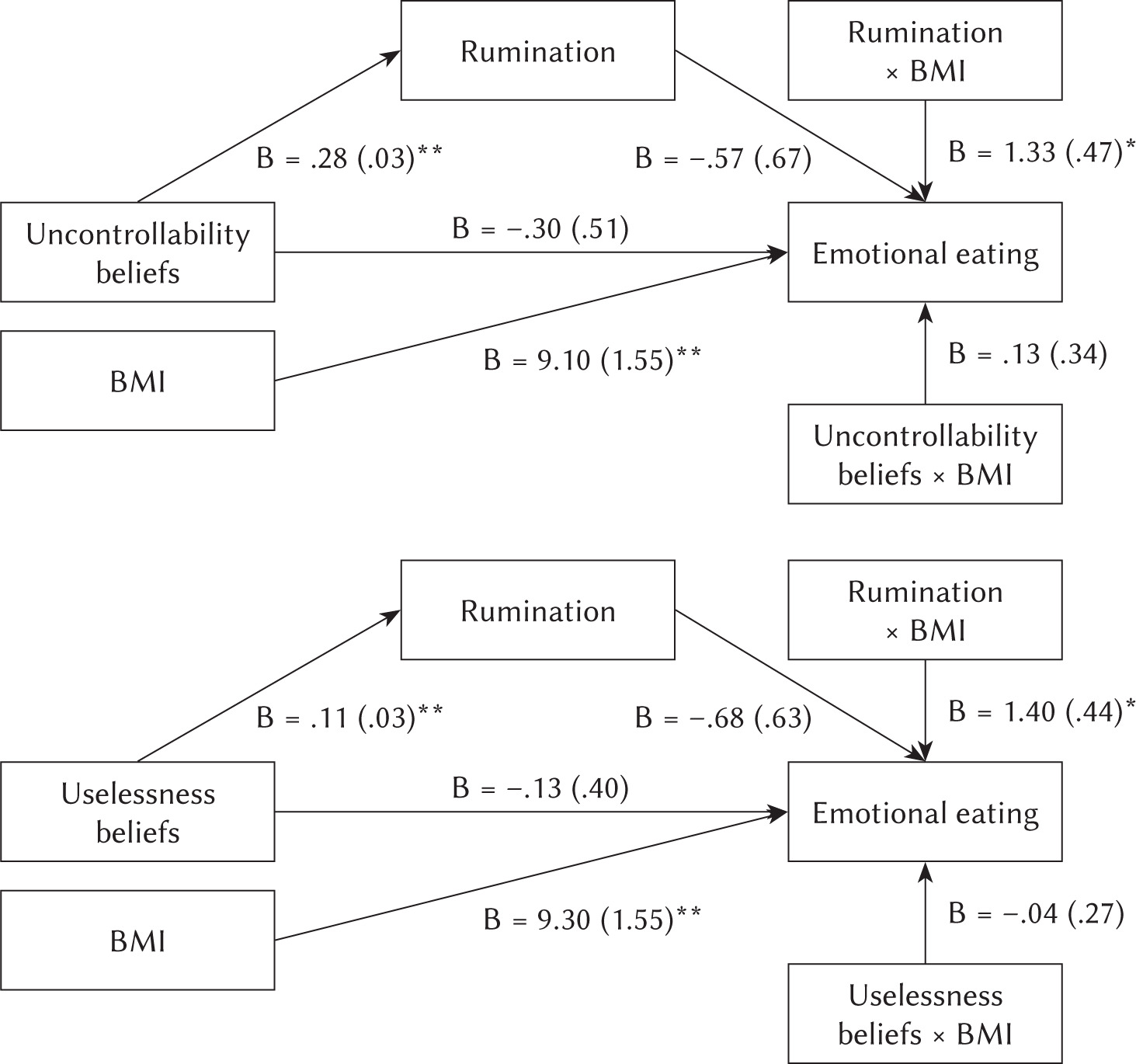
Moderated mediational models of the associations between beliefs about negative emotions, rumination, emotional eating and body mass index (BMI), controlling for gender
Note. BMI was grouped as underweight/normal (< 25) vs. overweight/obese (≥ 25). Unstandardized regression coefficients are reported. Standard errors are given in parentheses. *p < .01, **p < .001.
The second analysis tested the mediating role of rumination in the relationship between usefulness beliefs and EE. The model explained 9% of the variance (R2 = .09). Usefulness beliefs were significantly associated with rumination (a path; B = 0.11, SE = 0.03, t = 3.88, p < .001). Rumination was significantly associated with EE (b path; B = 1.24, SE = 0.22, t = 5.52, p < .001). There was a significant indirect effect of usefulness beliefs on EE through rumination (ab path); B = 0.14, 95% CI [.061, .244]. The total effect (c path; B = 0.06, SE = 0.14, t = 1.41, p = .682) and the direct effect (c′ path; B = –0.09, SE = 0.14, t = –0.62, p = .534) of usefulness beliefs on EE were not significant, suggesting that EB were related to EE only indirectly via rumination.
Next, a moderated mediation model exploring whether the associations between controllability beliefs and EE, and between rumination and EE, vary based on BMI levels was tested (Figure 2). The model was significant, F(6, 405) = 16.04, p < .001, and explained 18% of the variance (R2 = .18). Controllability beliefs were significantly associated with rumination (B = 0.28, SE = 0.03, t = 8.14, p < .001), but rumination was not significantly associated with EE (B = –0.57, SE = 0.67, t = –0.85, p = .394). There was a significant interaction between rumination and BMI (B = 1.33, SE = 0.47, ΔR2 = .02, t = 2.83, p = .005) in predicting EE, whereas the interaction between controllability beliefs and BMI was not significant (B = 0.13, SE = 0.34, ΔR2 = .00, t = 0.37, p = .713). The bootstrapped confidence intervals for the index of moderated mediation indicated a significant conditional effect, 95% CI [.106, .634], suggesting that the indirect effect of controllability beliefs on EE through rumination varied as a function of BMI. Specifically, the conditional effect of rumination on EE (the b path) was stronger among overweight/obese individuals, B = 2.09, SE = 0.38, t = 5.43, p < .001, compared to underweight/normal-weight individuals, B = 0.76, SE = 0.28, t = 2.74, p = .006.
Lastly, a moderated mediation model assessing whether the associations between usefulness beliefs and EE, and between rumination and EE, vary based on BMI levels was tested. The model was significant, F(6, 405) = 15.51, p < .001, and explained 19% of the variance (R2 = .19). Usefulness beliefs were significantly associated with rumination (a path; B = 0.11, SE = 0.03, t = 3.89, p < .001). There was a significant interaction between rumination and BMI in predicting EE (B = 1.40, SE = 0.44, ΔR2 = .02, t = 3.16, p = .002), whereas the interaction between usefulness beliefs and BMI was not significant (B = –0.04, SE = 0.27, ΔR2 = .00, t = –0.14, p = .890). The bootstrapped confidence intervals for the index of moderated mediation was significant, 95% CI [.048, .297], suggesting that the indirect effect of usefulness beliefs on EE through rumination varied as a function of BMI. Specifically, the conditional effect of rumination on EE (the b path) was stronger among overweight/obese individuals, B = 2.13, SE = 0.36, t = 5.89, p < .001, compared to underweight/normal-weight individuals, B = 0.77, SE = 0.28, t = 2.75, p = .006.
DISCUSSION
The present study investigated the link between EB and EE in a sample of Turkish adults by testing the mediator role of rumination. Additionally, we tested two moderated mediation models to assess whether the relationships between EB and EE, and rumination and EE, are moderated by levels of BMI. Our findings supported the hypothesis that rumination would mediate the association between EB and EE. Moreover, BMI played a significant role in the pathway from rumination to EE, with stronger effects observed in participants with higher BMI.
The findings showed that beliefs about the uncontrollability and uselessness of negative emotions were positively associated with rumination, consistent with past research (e.g., Kneeland & Dovidio, 2020). Regarding uncontrollability beliefs, a perceived lack of control over emotional distress may activate mechanisms that hinder effective ER, thereby contributing to rumination. According to goal progress theory (Martin & Tesser, 2006), rumination arises from goal failure and persists until progress is made or the goal is abandoned, intensifying when the goal is important but difficult to achieve. Believing that negative emotions are uncontrollable may create a paradox because when individuals perceive these emotions as aversive and believe that they should be controlled, yet if regulation seems unachievable, this discrepancy may trigger rumination. Similarly, the view that negative emotions are useless may contribute to a nonaccepting attitude towards emotional distress (Karnaze & Levine, 2020) and may promote ruminating on the causes of negative emotions.
A major finding was the significant indirect effects of EB on EE through rumination, underscoring rumination as a key cognitive process. Previous research has linked rumination to EE (Kornacka et al., 2021; Smith et al., 2018); however, the present study was the first to examine its role as a mediating mechanism between EB and EE. It is known that rumination exacerbates negative affect and can initiate a cycle in which rumination and negative affect reciprocally intensify, increasing emotional pain (Blanke et al., 2022). Especially for those individuals with high levels of emotion dysregulation, maladaptive behaviors such as binge eating may serve to break this cycle (Selby et al., 2008). Eating in response to rumination may provide temporary relief, helping individuals escape emotional distress.
This study also contributes to the limited research on the specific association between EB and EE. The absence of a significant direct or total effect of EB on EE, with a significant indirect effect, indicates that EB were related to eating only indirectly, through rumination. This pattern is referred to as indirect-only mediation (Hayes, 2009), suggesting that rumination may represent a specific pathway linking EB and EE, rather than an overall association represented by the total effect. EB may operate by activating mental processes, such as rumination, which then influence eating behavior. This is inconsistent with the results of Strodl and Sorensen (2023), who found that dysfunctional EB are positively related to EE. However, they measured beliefs about one’s own emotions, not general EB. Such self-referential beliefs may more strongly represent ER difficulties and eating to alleviate distress. In contrast, general EB may reflect broader attitudes about emotions that are less directly linked to one’s behavior. However, causality cannot be inferred, and future research is warranted.
The results of the moderated mediation analyses have provided us with further insight into BMI’s role in these relationships. BMI moderated the pathway from rumination and EE, with stronger effects observed in overweight/obese individuals. This suggests that those with higher BMI may be more vulnerable to EE when they ruminate. Obesity has been linked to impairments in inhibitory control (Lavagnino et al., 2016). Similarly, rumination is associated with difficulties in inhibition and set-shifting, indicating an impairment in inhibiting internal thoughts and switching to a new trajectory of thought (Yang et al., 2017). Built on these findings, those with impaired inhibition capacity may be unable to disrupt ruminative thinking, and some of them might use eating to alleviate emotional distress, which would promote weight gain. However, this explanation is speculative, and BMI’s role might be influenced by other variables such as weight stigma and body dissatisfaction, rather than BMI itself. For example, weight stigma has been associated with depressive symptoms, anxiety, and EE (Wu & Berry, 2018). Individuals with higher BMI may experience greater negative affect due to stigmatizing social interactions, which in turn could trigger greater rumination and EE. On the other hand, BMI was not a significant moderator between EB and EE, suggesting that beliefs and eating were unrelated, regardless of BMI.
Our findings may hold implications for clinical practice. The observed link between EB and rumination suggests that interventions targeting dysfunctional EB might help individuals reduce their reliance on this maladaptive strategy. Cognitive-behavioral interventions can help individuals identify and challenge beliefs about negative emotions through cognitive restructuring and behavioral experiments. Our results also highlighted the potential role of interventions targeting rumination to prevent EE. Providing psychoeducation may help individuals recognize and disrupt rumination. Mindfulness-based practices may reduce rumination by fostering a non-judgmental awareness and acceptance of emotions (Hawley et al., 2014). Mindfulness-Based Eating Awareness Training, which aims to increase mindful awareness of hunger and satiety and to decrease reactive eating, can effectively reduce binge eating episodes (Kristeller & Wolever, 2014). This intervention could be adapted to include components to target rumination. Because rumination was more strongly associated with EE in overweight/obese individuals, addressing rumination in this group could be particularly beneficial.
The present study has several limitations. First, the sample was predominantly female and highly educated, limiting the generalizability to the broader Turkish population. Future research should include a more balanced demographic distribution. Furthermore, the cross-sectional nature of the study precludes drawing conclusions about the direction of effects and causality between variables. For example, EE may trigger rumination, suggesting a bidirectional relationship. Future studies are suggested to employ a longitudinal design to capture these complex associations. Also, laboratory studies that manipulate EB can be used to shed light on their potential effects on state rumination and EE. Moreover, we did not assess participants for EDs, which is a limitation, given that EE is more common in individuals with EDs (Reichenberger et al., 2021). Even though most participants reported no lifetime psychiatric diagnosis, there is a possibility that participants with EDs were included and may have affected the findings. Future studies are suggested to assess whether the observed relationships differ in individuals with and without a diagnosis. Additionally, underweight and normal-weight participants were merged, which may have influenced the moderation results. Therefore, these findings should be interpreted with caution. Finally, we relied on self-report measures, which may be a source of response bias. We suggest that future studies use objective BMI and incorporate more objective measures, such as food diaries or behavioral observations.
In conclusion, the current study highlighted the role of rumination as a mediator between beliefs about negative emotions and EE. Our findings suggest that EB and EE are indirectly, but not directly, related through ruminative thinking, with stronger associations between rumination and EE observed in individuals who are overweight/obese. These results emphasize the potential importance of targeting EB and rumination to prevent EE, as well as tailoring interventions for individuals based on BMI.