Background
Dimensions of cognitive functioning, such as perceiving reality, imagination and problem-solving skills, or particular states of self and global consciousness, are continuously studied in psychological research. The cognitive system processes life experiences and emotions, thereby affecting memory, differentiating one’s personality traits, and influencing one’s behaviour and way of functioning (Burdick & Goldberg, 2008). One, unfortunately common, life experience is humiliation, resulting in victims’ memories of a humiliating situation remaining vivid in their minds, regardless of the time that has passed (Li et al., 2024). This characteristic resembles another psychological phenomenon described in a similar way – rumination, which is repetitive negative thinking (RNT) focused on the experiences of the individual and is characterised by recurrent and prolonged wanderings of thoughts toward personal fears. The overall construct of humiliation in this paper consists of two factors: past experiences of humiliation and fear of humiliation (Hartling & Luchetta, 1999). The fear accompanying potential, future situations of humiliation inhibits one from reaching full potential or self-development and thus fully exploring one’s personality (Hartling & Luchetta, 1999). It is an interpersonal and often triadic phenomenon, as it involves the person being humiliated, the humiliator, and the witness (Żenda et al., 2021).
In contrast to the above, posttraumatic growth (PTG) describes a different outcome in which adversity can lead to positive psychological change. However, experiences of humiliation and rumination may act as key barriers to PTG. The literature identifies several such barriers, including a lack of a supportive environment, recurrent exposure to trauma, and stigma and shame (Fayaz & Saharan, 2025). Accordingly, humiliation is studied from three perspectives: as an internal experience (a feeling), as an external event (a conflict), or as systemic conditions (systemic discrimination; Hartling & Luchetta, 1999). Acts of public humiliation provoke the victim’s self-conscious emotions of humiliation, shame, embarrassment, and guilt (Leask, 2013). Rumination intensifies our current mood and confirms our previous beliefs, while the experience of humiliation is an act that causes a change for the worse in the position of the victim and in the victim’s feelings about himself and his relationship to the world. It is worth noting that RNT has three subscales: core features of RNT, referring to the repetitive and intrusive nature of such thoughts; the unproductiveness of RNT, reflecting their perceived ineffectiveness in solving problems; and the mental capacity captured by RNT, measuring the extent to which RNT dominates attention and disrupts functioning.
The humiliated person experiences reduced levels of concentration or creativity (Hassankhani et al., 2018), impaired problem solving (Smith & Alloy, 2009), and also greater emotional reactivity and poor cognitive control, particularly in stressful situations (Wang et al., 2020). In retrospect, personal and social problems caused by rumination can be reduced by improvement in planning and acting on problem solving strategies, which is a result of cognitive regulation of emotion. This is linked to an increase in well-being (Rashidifar & Karami, 2025), which in the present study is understood as happiness. Happiness is an umbrella term for overall well-being and satisfaction with one’s own life – consequences of effective coping mechanisms, a sense of valuable abilities, and control over one’s life (Poprawa, 2012). Happiness reflects the hedonic path of optimal functioning after a distressing event (such as experience of humiliation), especially the levels of an individual’s efficiency in coping and achieving satisfaction with life after such an event (Kaleta & Mróz, 2023). In the eudaimonic perspective, happiness is identified with what makes a happy life possible – mainly individual capabilities (assets; Diener & Biswas-Diener, 2008) – described as a process of growth and development, connected with structural psychological dimensions such as personality, general representation of reality, and a value system (Delle Fave, 2014). Meanwhile, as described above, fear associated with humiliation and rumination may inhibit an individual’s development of full potential, and humiliation results in damaged identity (Żenda et al., 2021).
One of six dimensions of psychological well-being is an ability to build positive, fulfilling and close connections (Puchalska-Wasyl, 2025). In order to express concern for others, one needs to trust people, that is, expect positive outcomes of their behaviour (Jasielska & Rajchert, 2020). The level of one’s happiness, however, might be worsened by experiencing humiliation, as it is strongly associated with disrupted relationships with loved ones but also with a desire for revenge alongside a personal sense of injustice combined with the absence of compensation for the harm suffered (Leask, 2013). Furthermore, rumination can intensify the emotional experience of anger. Recalling, preserving, and ruminating on clearly remembered experiences of humiliation can motivate aggressive behaviour (Coleman et al., 2007).
The experience of humiliation has serious consequences such as depression, suicide, desire for revenge, and terrorism (Elshout et al., 2017). Moreover, it is strongly associated with reduced self-esteem, emotional distress, depression, trauma, experiencing physical pain, and impaired sleep quality (Żenda et al., 2021). Engaging in rumination can intensify negative emotional states and reduce overall mood, independent of the initial emotional context, indicating that rumination itself is detrimental to emotional well-being (Jahanitabesh et al., 2017). Humiliation and rumination are dangerous and destructive to mental and physical functioning and can lead to suicidal thoughts and attempts (Lin et al., 2022). The theoretical outline above indicates implications for happiness, which is shaped by various aspects of life such as deep interpersonal relationships, job satisfaction, health and self-fulfilment, positive emotions, and involvement in various activities (Diener & Biswas-Diener, 2008). Nevertheless, it seems difficult to articulate a clear thesis on the relationship between the three study variables: humiliation, rumination and happiness. A key point is that happiness varies according to how an individual perceives life events (Satici et al., 2024), and perception seems to be associated with rumination, which in turn is linked to humiliation. The theoretical framework shows the similarity in the consequences of experiences of humiliation and rumination for well-being, although there are not enough research studies linking the two variables of humiliation and happiness in direct association. The study of such constructs and the mutual dynamics between them is important in the context of both scientific understanding of human experiences and development of possible preventive and supportive interventions among individuals and communities. Thus, the first aim of this study was to investigate the variables’ relationship. The second aim was to examine the role of rumination in happiness. Thirdly, the study investigated the role of rumination in the potential relationship between humiliation and happiness.
Therefore, the following research questions were formulated:
Participants and procedure
Participants
The participants were 323 (female n = 212, male n = 107 and other n = 4) from Poland. Age ranged from 18 to 79 years (M = 26, SD = 13.05), and most participants had higher (49.23%) or secondary (43.03%) education. The remaining 7.7% reported having primary or vocational education.
Measures
Oxford Happiness Questionnaire. Happiness was measured using the Oxford Happiness Questionnaire (OHQ; Hills & Argyle, 2002; Poprawa, 2012). The OHQ measures the complex construct of happiness, composed of satisfaction with one’s life as well as self-assurance and the personal resources that affect it. The Polish adaptation of Poprawa (2012), consisting of 26 items, was used due to the low discriminatory power of the three test items of the original tool (OHQ; Hills & Argyle, 2002). Respondents indicated their level of agreement with each statement by selecting a number on a 6-point scale, ranging from 1 (strongly disagree) to 6 (strongly agree). In this study, Cronbach’s α = .89.
Perseverative Thinking Questionnaire. Rumination was measured by the Perseverative Thinking Questionnaire (PTQ; Ehring, 2011; Kornacka et al., 2016). The PTQ is a content-independent measure of RNT. The 15-item self-report measure designed to assess the process characteristics of perseverative thinking has a 5-point Likert scale ranging from 0 (never) to 4 (almost always). The PTQ was developed to examine five factors representing the core characteristics of RNT, following the authors of PTQ: repetitive (repetitiveness of negative thinking), intrusive (intrusiveness of negative thought patterns), difficult to disengage from (difficulty of disengaging), unproductive (perceived unproductiveness of RNT), and capturing mental capacity (RNT capturing mental resources). PTQ measures a general tendency toward dysfunctional repetitive thinking rather than event-specific rumination. In this study, Cronbach’s α = .95.
Humiliation Inventory. The adaptation of the Humiliation Inventory (Hartling & Luchetta, 1999) was used to measure humiliation. A full adaptation using the back-translation procedure was carried out in previous studies by the author, where care was taken to ensure the appropriate factor structure and reliability of this tool (N = 179). Following the Portuguese adaptation by Cardoso et al. (2019), it was shown that the items load the factors in the same way as in the above studies and explain a total of 63% of the variance. The original scale consists of 32 test items and is divided into two scales: the cumulative humiliation subscale (α = .95), referring to past experience of humiliation; the fear of humiliation subscale (α = .97); and the sum of the previous two as the overall result of the tool, the general humiliation scale or feeling of humiliation (α = .97). Respondents rate how seriously they have been hurt on a 5-point scale, ranging from 1 (to a very minor extent) to 5 (to a very large extent).
Procedure
The study was a voluntary and anonymous online survey conducted through the Qualtrics platform. All persons over the age of 18 were eligible to participate in the study. The survey was distributed via social media. Incomplete cases were excluded from the analysis. The respondents were informed that they would participate in a survey about difficult life situations and their feelings of happiness. All participants gave written informed consent, which indicated that all data would be treated as strictly confidential. The questionnaire included the contact data of a psychologist if needed. The project was approved by the Ethics Committee of SWPS University (approval number WKEB85/07/2023).
Data analysis
Analyses were performed using IBM SPSS 28 and JASP 0.17.1.0 software for simple statistics and evaluation of data normality. Correlation analysis and tests of differences were used to meet the study’s aims. A mediation effect was tested using PROCESS version 4.2 (Hayes, 2022) to examine the role of rumination in the relationship between humiliation and happiness. The mean scores for all items were used to examine the mediation model, as each of the tools used, according to the authors, has this possibility.
An a priori power analysis was conducted using G*Power (version 3.1.9.7) to determine the required sample size for a multiple regression model with three variables. The analysis was based on the following parameters: a medium effect size (f2 = .35), an alpha level of .05, and desired power of .80. The power analysis indicated that a total sample size of 36 participants would be required to detect a significant effect (F-test with a noncentrality parameter λ = 12.60, critical F(3, 32) = 2.90. Given the actual sample size of 323, the achieved power was 1, indicating that the study was sufficiently powered to detect effects of this magnitude.
Results
The means and standard deviations of the variables were checked (Table 1). The distributions were close to normal distributions based on the results of skewness and kurtosis, which did not exceed an absolute value of 1.
First, Spearman’s rho correlation matrix was examined to check the relationships between the variables in the model and their subscales (Table 1). All correlations were found to be significant. Happiness (OHQ) correlated negatively with the level of rumination, meaning that those reporting lower levels of happiness were characterised by higher levels of rumination. The intrusiveness of rumination subscale (PTQ_INT) correlated weakest, although still significantly, at a moderate level with happiness, and the perceived unproductiveness of rumination subscale (PTQ_UNP) correlated strongest. In the relationship of happiness with humiliation, moderately strong associations were observed with the cumulative humiliation score, HI, and the fear of humiliation subscale. Meanwhile, the relationship of cumulative humiliation and the fear of humiliation subscale with rumination was moderate and positive, and slightly weaker for the past experience of humiliation subscale. Cumulative humiliation was most strongly associated with the difficulty of disengaging and slightly less strongly with the repetitiveness of rumination. The strongest associations between the subscales of both questionnaires were found between the experience of humiliation and the perceived unproductiveness of rumination as well as the fear of humiliation and the difficulty of disengaging. Then, based on percentiles, three groups each were distinguished among the results of rumination and humiliation (low, medium, and high levels), which was necessary for further analyses.
Table 1
Means, standard deviations and Spearman correlation coefficients
[i] N = 320; rumination_REP ‒ the repetitiveness of RNT (repetitive negative thinking); rumination_INT ‒ the intrusiveness of RNT; rumination_DIF ‒ the difficulty of disengaging; rumination_UNP ‒ the perceived unproductiveness of RNT; rumination_CAP ‒ RNT capturing mental resources. All relationships were significant at p < .001. Correlation coefficients higher than .50 are considered strong correlations, above .30 are considered moderate correlations, and less than .30 are considered weak correlations (Cohen, 1992).
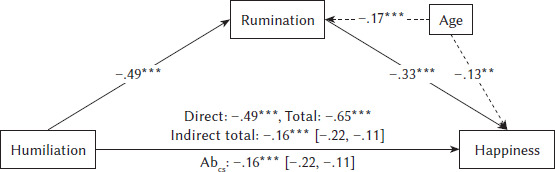
A mediation analysis using Hayes’ PROCESS Model 4 was conducted to examine whether rumination mediated the relationship between humiliation and happiness (Figure 1). The overall model was significant, F(3, 320) = 96.43, p < .001, explaining 47.8% of the variance in happiness. The negative direct effect of humiliation on the happiness was significant (β = −.49, SE = .05, p < .001, 95% CI [−.39, − .48]). The reduction in the standardised beta coefficient (c = −.65, c’ = −.49) and the significant completely standardised indirect effect (abcs = −.16, SE = .03, 95% CI [−.22, − .11]) suggest a partial indirect effect of rumination. The indirect effect size was medium (Kenny, 2025). Age was added as a covariate in the mediation model to evaluate whether it affected the results. Age had a weak negative effect on rumination and happiness, which means that this relationship may be stronger in younger persons.
Discussion
The findings are interpreted in light of relevant theoretical frameworks concerning emotional regulation, cognitive appraisal, and social-emotional well-being.
The relationship between the experience of humiliation and perceived happiness
Humiliation correlates negatively with the level of happiness: the higher the level of humiliation, the lower the level of perceived happiness. Humiliating experiences, particularly those involving public exposure or power imbalances, significantly correlate with heightened depressive symptoms and decreased life satisfaction (Li et al., 2024). Consequently, there may be a reduction in health and personal resources for effective (cognitive) coping (Elshout et al., 2017) with difficult and hurtful experiences such as humiliation. Humiliation affects emotions, such as shame and guilt, and its implications for therapy, as well as leading to emotional distress and affecting overall happiness (Żenda et al., 2021). Humiliation is associated with a heightened susceptibility to depressive symptoms and identity disturbance, especially in contexts marked by power asymmetries (Rossetti et al., 2017). Fernández et al. (2015) revealed the paradoxical nature of humiliation, associated with both approach and avoidance tendencies, amplifying its impact on happiness. Affective forecasting theory suggests that individuals might overestimate the long-term effects of humiliation, leading to prolonged dissatisfaction and reinforcing depressive states (Leidner et al., 2012). Consequently, the anticipation of future humiliation can hinder individuals’ openness to social interactions and personal growth, reinforcing a costly cycle of vulnerability and reduced well-being (McCauley, 2017).
Furthermore, according to the procedural approach to well-being in the concept of psychological wealth, emotions should be treated as functional processes dependent on the interpretation of events, rather than as a homogeneous negative affect (Diener & Biswas-Diener, 2008). It is also worth remembering that humiliation is a construct distinct from shame and guilt, as it presupposes constitutive relational harm: public (or socially visible) humiliation and loss of status in conditions of power asymmetry and a sense of injustice, which encourages the attribution of blame to external factors and feelings of powerlessness and outrage (Gonzalez-Puerto & Fernández, 2025). Shame and guilt, on the other hand, have a more intrapsychic core of self-esteem: shame reflects a global negative assessment of oneself, while guilt concerns the assessment of one’s own actions and moral responsibility, more often evoking corrective tendencies (Miceli & Castelfranchi, 2018).
Rumination affects happiness
Nolen-Hoeksema’s (2003) response styles theory suggests that individuals who engage in ruminative thinking are more likely to experience prolonged negative affect and diminished happiness. The association between rumination and decreased happiness is underscored by this theory, which emphasizes that prolonged negative emotions are linked to ruminative tendencies (Ricarte et al., 2018).
Higher level of rumination corresponds to a lower level of happiness. The intrusiveness of rumination, such as intrusive thoughts, is least associated with the level of happiness. This is noteworthy, as many psychotherapeutic approaches and interactions are based on modifying automatic thoughts (Ladouceur et al., 2000). Individuals with lower happiness levels tend to spend more time ruminating on negative feelings and thoughts, have less satisfying social function, and envision the future with less detail (Luo et al., 2014). Evidence supports that high levels of rumination correlate with attentional biases towards negative emotional stimuli, making it difficult for individuals to process positive information and further harming emotional health (Arënliu et al., 2023). The perceived unproductiveness of rumination correlates strongest with the level of happiness, which can lead to a lack of empowerment, hope, and effectiveness in coping, thereby influencing happiness (Eisma et al., 2015). Perceived unproductiveness of ruminative thoughts has a detrimental effect on happiness (Jahanitabesh et al., 2017), and the difficulties in disengaging from negative thinking hinder the application of adaptive coping strategies (Debeuf et al., 2021). Thus, the emotional regulation issues rooted in rumination emerge as critical factors influencing overall happiness, stressing the necessity for targeted therapeutic interventions in addressing these cognitive patterns (Takai et al., 2023).
Rumination partially mediates the humiliation-happiness relationship
Research indicates that rumination serves as a partial mediator in the relationship between humiliation and happiness. For example, rumination mediated the relationship between emotional abuse and depressive symptoms (Raes & Hermans, 2008), and also mediated the relationship between stress and negative emotions (such as anxiety, depression, anger). Rumination not only predicts heightened emotional responses to stressful life events but also mediates the relationship between such events and anxiety or depression symptoms (Stangier et al., 2021). It is also noteworthy that intense emotions such as anger, which can result from humiliation, reduce happiness through rumination, and their impact can be modulated by processes such as forgiveness or self-compassion (Elemo et al., 2018). Cognitive mediation models elucidate how cognitive processes, particularly rumination, convert adverse experiences such as humiliation into negative emotional outcomes (Psychogiou et al., 2017). Notably, rumination is an active cognitive process that contrasts with passive responses and tends to solidify negative self-views and interpretations of others (Kang & Kim, 2021). It is possible that the mere experience of humiliation may be sufficient to reduce feelings of happiness due to the power and painful potential of such experiences, but ruminating about these events may reinforce this phenomenon. Therefore, addressing rumination in therapeutic contexts may yield significant benefits for individuals recovering from emotionally distressing experiences (Psychogiou et al., 2017). This necessitates therapeutic approaches that differentiate between negative and constructive rumination, aiming to cultivate the latter while diminishing maladaptive thought patterns (Candia et al., 2023).
Conclusions
In the present study, rumination appeared to partially explain the relationship between difficult, humiliating experiences and subsequent happiness. Although the study was cross-sectional and does not prove causal relationships, it can be concluded from other studies cited on the nature of the phenomena described that rumination should also be controlled and assessed to reduce the impact of humiliation on overall happiness and functioning, for example in the therapeutic process. The fear of humiliation subscale may provide the best answers when looking for a potentially significant variable in the above relationship. As stated in section 4.1, indicated fear of humiliation, coping styles and rumination are variables that should be explored when investigating the impact of humiliation on perceived happiness.
The study has some limitations, including using a cross-sectional survey, which limits the analysis of two-way relationships. It relied on self-report questionnaires, which may create a biased picture of the respondents. A strength of the study may be the use of reliable questionnaires for subjective evaluations. The results were not controlled for sociodemographic variables, which should be done in future studies. To deepen these considerations, further exploration of additional factors that individuals encounter during the experience of challenging emotions is necessary. Conducting longitudinal or experimental studies would be invaluable in capturing the causal dynamics inherent in these phenomena. Such investigations could illuminate the nuanced interplay between humiliation, fear of difficult emotions, coping strategies, and subsequent happiness, providing a more comprehensive understanding of these complex emotional processes.